Gavior Journal · Software Engineering · 6 min read
SaaS Approval Workflow Design and Audit Trails
A SaaS approval workflow should define request states, authorised reviewers, approval versions and timeout rules. Its audit trail should connect each decision to the actor, request version and resulting action. These controls make approvals reviewable; they do not establish regulatory compliance by themselves.
Gavior Editorial Team
Software and automation editorial team
Published: 2026-10-28Updated: 2026-10-28
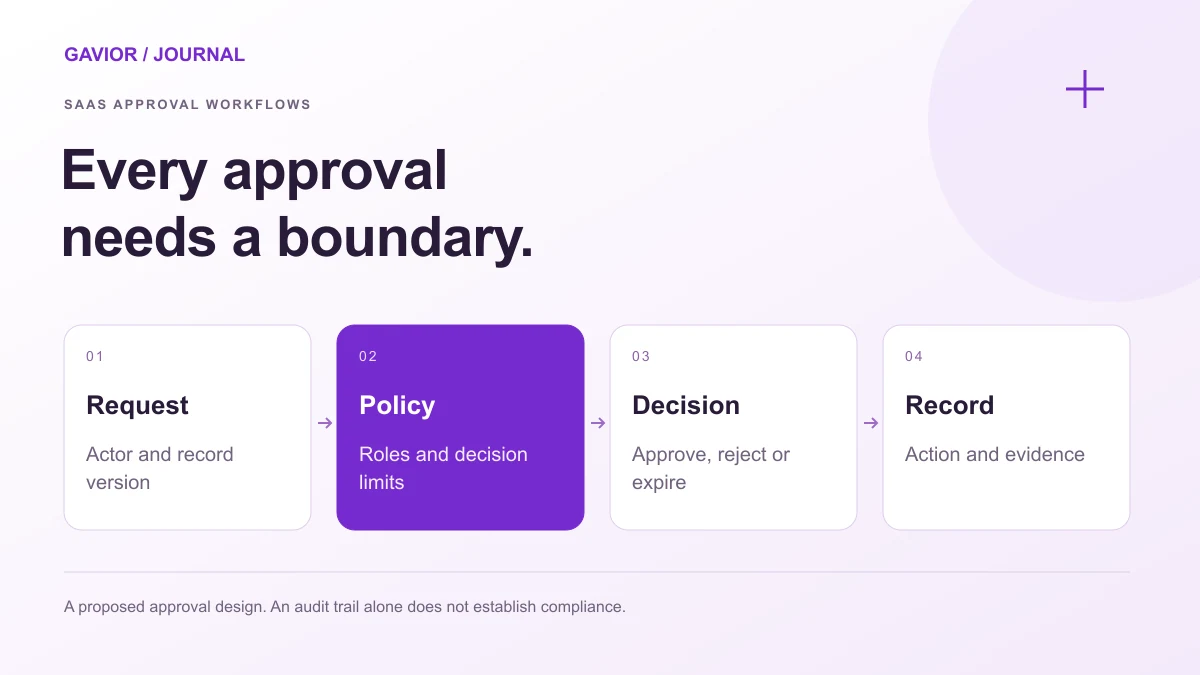
An approval design framework. A workflow or audit trail alone does not establish legal compliance. View full-size image ↗
An “Approve” button is only the visible part of the process. The engineering problem is preserving a decision's meaning when requests change, reviewers leave and notifications arrive late. This checklist focuses on that boundary within .
Make your move
Ready to turn a better idea into a better business?
Define states around business meaning. Keep approval separate from execution: a request can be authorised while its downstream action remains incomplete.
State
Meaning
Permitted next step
Draft
The requester is preparing the submission
Edit, submit or discard
Pending review
A specific version awaits an authorised decision
Approve, reject, withdraw or expire
Changes requested
The reviewer needs a revised submission
Create and submit a new version
Approved
The required decision is recorded
Start the authorised action
Execution pending or failed
The action has not finished
Investigate or recover under the agreed rules
Completed
The required business outcome is confirmed
Retain the decision and outcome references
Document cancellation and rejection as explicit outcomes. Avoid a generic “done” flag that could mean approved, cancelled or successfully executed. State rules should specify whether withdrawal remains possible after approval and who handles an action that has already begun.
Who is allowed to approve each request?
Write an authority matrix covering request type, organisation, applicable limits and reviewer role. Decide whether a requester may approve their own submission, whether all reviewers must agree and what a rejection does to parallel reviews. These are business policies for the owner to approve.
Enforce the rule when the decision reaches the server. Showing a button only to reviewers is a user-interface choice; the decision endpoint must still check the current actor, organisation, role and request state. Review access again when a reviewer loses a role or a delegation ends.
Separate permission to decide from permission to execute. An integration that carries out an approved change should receive the specific authorised request reference rather than an unrestricted instruction to change any customer record.
How do you prevent approval of an outdated request?
Bind every decision to an immutable submission version. Record the fields, attachments and policy version relevant to that decision. If a material field changes, invalidate or supersede the pending approval according to the agreed rule and send the revised version for review.
Show the version and a concise change summary to the reviewer. A stale email link should open the current status and explain why its original action is unavailable. Silently approving the latest content would attach consent to information the reviewer never saw.
Conditional writes can support this check. RFC 9110's If-Match semantics describe preventing state changes when a representation no longer matches the supplied entity tag. An application can also use a transaction with a request-version check. The required outcome is that a decision for version 3 cannot authorise version 4.
Treat simultaneous decisions explicitly. If two reviewers act together, the stored transition must respect the approval rule and preserve both attempts without executing the approved action twice.
What happens when a reviewer is absent or a request expires?
Distinguish a reminder, delegation and escalation. A reminder prompts the same reviewer. Delegation gives another authorised person a defined responsibility. Escalation moves an overdue case to the person permitted to resolve it.
For delegation, record the original reviewer, delegate, scope, effective period and authorising actor. Decide whether an existing assignment moves or a new review task is created. Prevent both assignments from remaining independently actionable when the policy allows only one decision.
A timeout should create an explicit outcome or owned exception. It should not silently become approval. Put these rules into the automation discovery workshop brief so notification behaviour does not become an accidental policy decision during implementation.
What belongs in the approval audit trail?
Store enough context to reconstruct a decision without copying every sensitive field into logs. Useful event attributes include the request and organisation references, submission version, actor, action, prior and resulting state, timestamp, reason and downstream operation reference.
The OWASP Logging Cheat Sheet recommends recording event context and protecting logs from unauthorised access and modification. It also identifies sensitive data that should be excluded. Apply those principles to the approval history and its exports.
Agree access, retention and correction procedures with the responsible owner. If an event needs clarification, preserve the original and add a linked correction under the agreed policy rather than silently rewriting history. An audit trail can support investigation and assurance work; a compliance claim needs the applicable requirements and independent assessment of the wider controls.
What does this look like in a real workflow specification?
Hypothetical example: A SaaS account manager requests an additional user allowance for a customer. This illustrates requirements, not a Gavior client result.
The request captures the customer, allowance, expiry and reason. An operations reviewer can approve only the submitted version for their organisation. After submission, the requester changes the expiry. The system supersedes the pending version, records the change and requires a fresh decision.
An old notification cannot approve the revised request. After a valid approval, a separate operation applies the allowance and records its outcome. If that operation fails, the request remains approved with execution incomplete. The operator uses the workflow monitoring and recovery procedure rather than asking the reviewer to approve the same unchanged request again.
Which acceptance checks should a buyer request?
Ask for demonstrations using representative requests and expected event histories:
An unauthorised actor cannot approve through the interface or direct endpoint.
A decision against a superseded version does not change the current request.
Simultaneous or repeated submissions cannot repeat the authorised business action.
Delegation expiry and reviewer removal change access as specified.
A timeout, cancellation and failed execution remain distinguishable.
An authorised operator can reconstruct the request, decision and outcome from their references.
Gavior can scope these behaviours within SaaS development. Discuss an approval workflow with the request types, authority rules and redacted examples of changes or exceptions your team encounters.
Frequently asked questions
Is approval the same as completing the requested action?
No. Approval authorises an action under defined conditions. Completion requires evidence that the action finished. Record them separately so an integration failure does not appear as either a rejection or successful execution.
Should editing a request always restart approval?
Define which fields affect the decision. Material changes should trigger the agreed reapproval rule. Even permitted non-material edits need a clear history so reviewers and operators can identify what changed after submission.
Can a delegate approve any request assigned to the original reviewer?
Only if the agreed delegation scope allows it. Check the request type, organisation, limits and delegation period when the decision is made, and record the delegate alongside the original assignment.
Does an audit trail make a SaaS application compliant?
No. An audit trail provides evidence of recorded activity. Compliance depends on the applicable obligations and the wider system, policies and operating controls. Define those requirements with the responsible specialists before making a compliance claim.
G
Gavior Editorial Team
Software and automation editorial team at Gavior
The Gavior Editorial Team shares practical guidance on product design, software engineering, cloud delivery and AI automation.