
Gavior Orbit
A connected workspace for website audits, content opportunities, editorial review and publishing automation.
Your idea. A focused first release.
Gavior provides SaaS and MVP development services for startup founders, covering product scoping, UX design, application development, integrations and deployment. Projects start with an agreed customer workflow, scope, milestones and handover responsibilities.
An early idea or an existing prototype is enough to start. No payment to send a brief.
Selected work
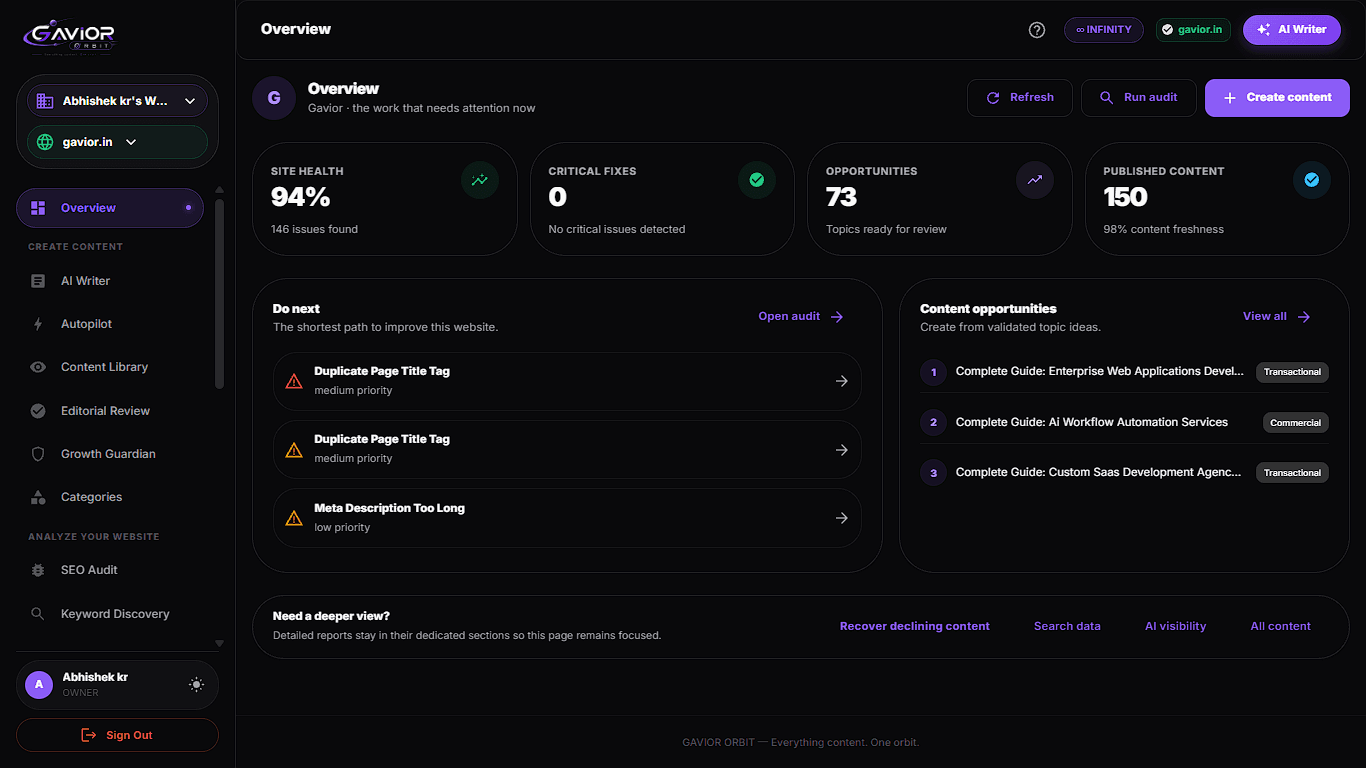
Gavior Orbit is our own SaaS product; the Prop Firm Platform is client work. Explore the actual interface and workflow behind each.
A connected workspace for website audits, content opportunities, editorial review and publishing automation.
A trader command center that brings funded accounts, challenge progress, trading rules and payout actions into one workspace.
SaaS & MVP engagements
Start with the decisions that shape your budget. Agree the scope and commercial terms before committing to delivery.
Turn your product idea into a first release you can evaluate before committing to development.
Fixed fee agreed before kickoffBring the agreed workflow to life, with working demonstrations and clear acceptance criteria.
Milestones priced after scopingPrioritise the next improvements around customer feedback and the way your product is being used.
Monthly scope and capacity agreedEvery engagement receives a written scope and quote. Build cost depends on workflows, integrations and release requirements. Hosting, third-party subscriptions and usage fees are identified separately.
Scope the complete workflow
Your proposal defines the features, integrations, acceptance criteria and operational responsibilities included in the engagement.
| Area | What we define together |
|---|---|
| Product scope | Target users, the core workflow, priorities and exclusions. |
| User experience | Customer journeys, screens, administration and error states. |
| Application development | The agreed workflows, accounts, permissions and integrations. |
| Release preparation | Acceptance checks, deployment, documentation and handover. |
| Ongoing development | Support responsibilities and a prioritised improvement backlog. |
Authentication, tenant boundaries, subscriptions and payment integrations are included where the approved product scope requires them. Every first release needs a complete primary journey; a list of screens alone is not a release scope.
See a connected workflow in our own product: Orbit brings content preparation, editorial review and publishing into one workspace. Its walkthrough explains the integration boundaries; interface figures are not customer revenue results.
Review the Orbit implementationBuilt around the first customer
A focused first release helps you get feedback before committing to an entire product roadmap.
You have domain knowledge, a manual process or feedback from potential customers. We can help define the core journey, prototype it and turn an approved scope into working software.
Bring the design, existing application or AI-assisted build. We’ll review the workflow, code and integrations before recommending what to keep and what needs further work.
How delivery works
The proposal defines the people involved, review rhythm, deliverables and responsibilities.
Discuss the problem, potential users, current evidence and the job the first release needs to do.
Review the prototype, essential features, risks, ownership, budget and acceptance criteria.
See progress through agreed demonstrations. Review changes to scope, price and timing before they proceed.
Deploy with agreed checks, documentation, account access and a clear support arrangement.
Agree the handover before the build
Use this checklist to review the proposal. The agreement names the included documents, access and operating duties; ongoing support is scoped separately.
| Area | What the agreement should identify |
|---|---|
| Source and access | Repository access, ownership and licence terms, provider-account owners and the access to transfer. |
| Release evidence | Accepted customer journeys, permission checks, known limitations and any unresolved items with an owner. |
| Operating instructions | Environment-variable names, deployment and rollback steps, and agreed backup/recovery responsibilities. Secrets are transferred securely, never in a public document. |
| After launch | Who monitors the application, handles incidents and pays recurring charges; the agreed support boundary and separate improvement backlog. |
For a worked release boundary and observable acceptance checks, use the SaaS scope checklist. Hosting, backups and support are not assumed to be included simply because development is complete.
A proposal you can evaluate
An estimate needs a defined release boundary. We identify what is included, what is deferred and which recurring charges sit outside development.
| Factor | What needs clarification |
|---|---|
| Workflows | Number of customer journeys and administration tasks. |
| Accounts and permissions | User roles, access rules and tenant boundaries. |
| Integrations | Payments, external APIs, email and other services. |
| Existing systems | Code quality, data migration and compatibility. |
| Release requirements | Testing, deployment, documentation and support. |
Hosting, payment-provider fees, email services and AI usage are identified separately. Review SaaS engagement options or custom software development for an existing business workflow.
Before you commission a build
Use these planning guides to describe the customer, scope and constraints. They are practical starting points, not fixed quotes or delivery promises.
Use a worked example and acceptance checklist to separate the first release from later ideas.
Read the guideSee the inputs, exclusions and recurring costs a useful proposal should explain.
Read the guideCheck the workflow, data access, integrations and release responsibilities before extending it.
Read the guideBefore you commit
Scoping, UX design, application development, agreed integrations, testing, deployment and handover. The proposal specifies which workflows and operational responsibilities are included.
Cost depends on workflows, design, integrations, data handling and release requirements. Gavior agrees the scope sprint fee before kickoff and prices build milestones after scoping. Hosting and third-party usage fees are identified separately.
Timing is agreed after reviewing scope, dependencies and review availability. The proposal defines milestones and acceptance criteria; changes to scope are reviewed before their effect on price and delivery is accepted.
Yes. Gavior can review an existing application, design or AI-assisted prototype and recommend what to retain, improve or rebuild, based on the code, integrations and product requirements.
Ownership, third-party licences, source access, hosting accounts and support responsibilities are defined in the agreement. Handover includes the documentation and access specified in the approved scope. Further development and support can continue through an agreed iteration engagement.
A useful first conversation
Tell us who the product is for, the problem it solves and where you are starting. Add your budget or launch target if you know it. You can share detailed requirements later.
No payment to enquire. Scope, price and timing are agreed before work starts. Send a short description first; do not include passwords, API keys or customer data.
Your idea, current prototype and the workflow your users need to complete.
A scope sprint, an MVP build or an improvement to your existing product.
Included work, milestones, acceptance criteria, exclusions and handover responsibilities.
Sending a brief starts a discussion. It does not commit you to a paid engagement.