SaaS MVP Scope Checklist: A Worked Release Example
Gavior Editorial Team
Product and engineering editorial team
Published: 2026-10-27Updated: 2026-11-07
Define a SaaS MVP around one complete workflow. Use a worked release example, exclusions and acceptance checks to prepare a development brief.
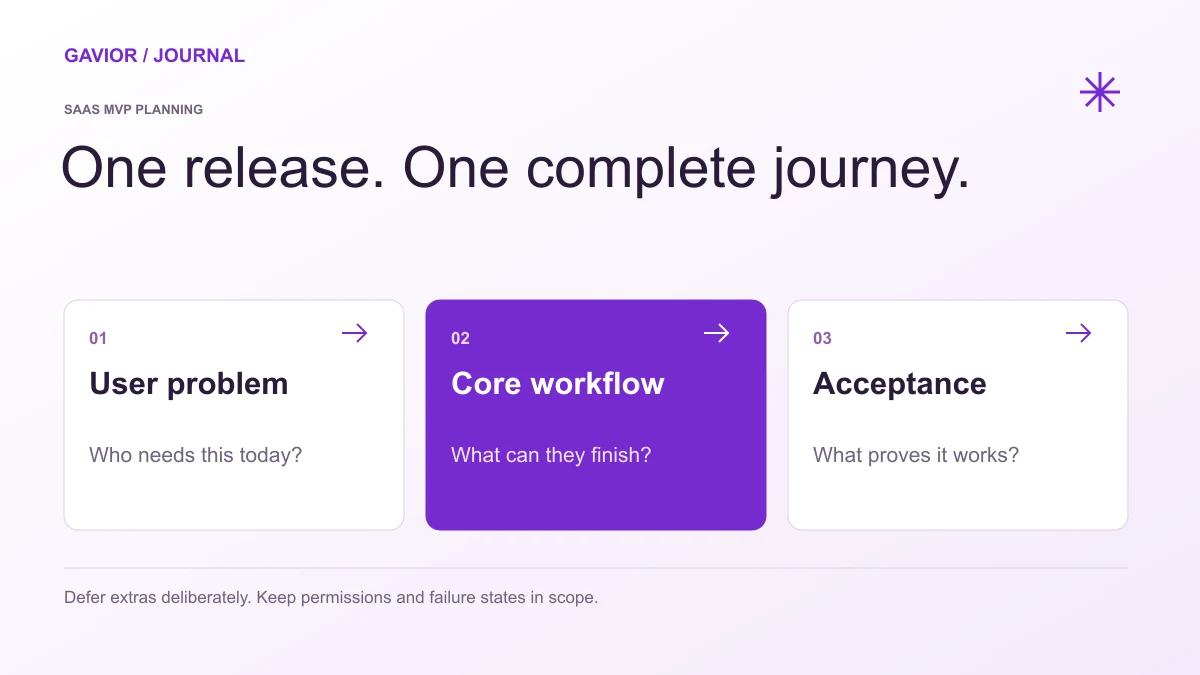
Define one complete customer journey and the evidence needed to accept it. View full-size image ↗
A SaaS MVP scope should name the primary user, the task they need to finish, the data and permissions involved, and the checks that demonstrate a working release. Include the operational handoff and failure states needed for that task. Keep unrelated features in a separate backlog.
Make your move
Ready to turn a better idea into a better business?
This guide uses an illustrative service-request portal to show how Gavior's scoping approach can become a reviewable brief. It is a planning example, not a client case study or a fixed feature package. Explore SaaS and MVP development for the engagement options.
What is the customer actually trying to finish?
Write a single journey before listing screens. In this example, an existing business customer submits a service request, sees its reference and later checks its status. An operator reviews the request and updates that status. The useful outcome crosses both sides of the application.
The release boundary is: an authorized customer can submit and track their own request, and an authorized operator can manage it. It does not include a marketplace, customer-to-customer messaging or an AI scheduling assistant.
What belongs in the first release?
Include for this example
Define as later work
Customer sign-in and access to the correct organization's requests
Additional identity providers without a current need
Request form with agreed required fields
Arbitrary customer-designed forms
A reference and visible submission status
Complex messaging and social activity
Operator review and permitted status changes
Workforce routing and optimization
Useful error, empty and loading states
Decorative personalization
Basic support and release documentation
A separate native mobile app
These are decisions for this example, not universal SaaS requirements. A different product may not need accounts, organizations or operator review. Write down why each included capability is necessary for the customer's task.
How do you make the scope testable?
Replace "the dashboard works" with observable acceptance criteria. Agree who supplies test accounts and sample data, and who approves each outcome.
Situation
Acceptance check
A valid request is submitted
A saved request receives a reference and can be retrieved after a refresh
A required field is missing
The form identifies the field and preserves the other entered values
Submission is retried
The agreed retry behaviour does not create an unintended duplicate request
Another customer changes a request URL
The server rejects access to records outside that customer's permission boundary
The operator changes status
The customer sees the allowed new status for the same request
An external email service is unavailable
The saved-request status remains clear and delivery follow-up is defined
Permission checks must apply to the underlying data request, not only to hidden buttons. OWASP's authorization guidance is a useful reference when reviewing this boundary with the development team.
If launch readiness depends on response time or concurrent activity, add a separate SaaS performance testing plan. Define representative workflows, data and acceptance thresholds; a functional demonstration alone does not establish capacity.
What dependencies should the brief name?
Identify the owner of every external dependency: identity provider, email service, payment system, existing customer database and hosting environment. State which accounts exist, which access is available and whether a test environment can be used.
If the first release needs a payment integration, define what the payment enables. A checkout screen alone does not explain cancellation, failed payments, access changes or support handling. If payments are not needed for the first customer workflow, do not include them automatically because the product is called SaaS.
What should be handed over?
List the agreed source access, environment configuration, deployment instructions, operational contacts and support responsibilities. Define the difference between an acceptance defect, a new feature and ongoing operation. Put the exclusions beside the included scope so that both can be reviewed before development.
Use the SaaS handover checklist to check repository access, release evidence, operating instructions and after-launch ownership against the proposal. Record environment-variable names and the secure transfer process; do not paste live credentials or customer records into a brief.
Bring the customer journey, current evidence and the questions you cannot yet answer. A scope sprint can turn these into a prototype, release boundary, risk list and milestone estimate. Do not treat a checklist as a quote until the actual integrations and delivery requirements have been reviewed.
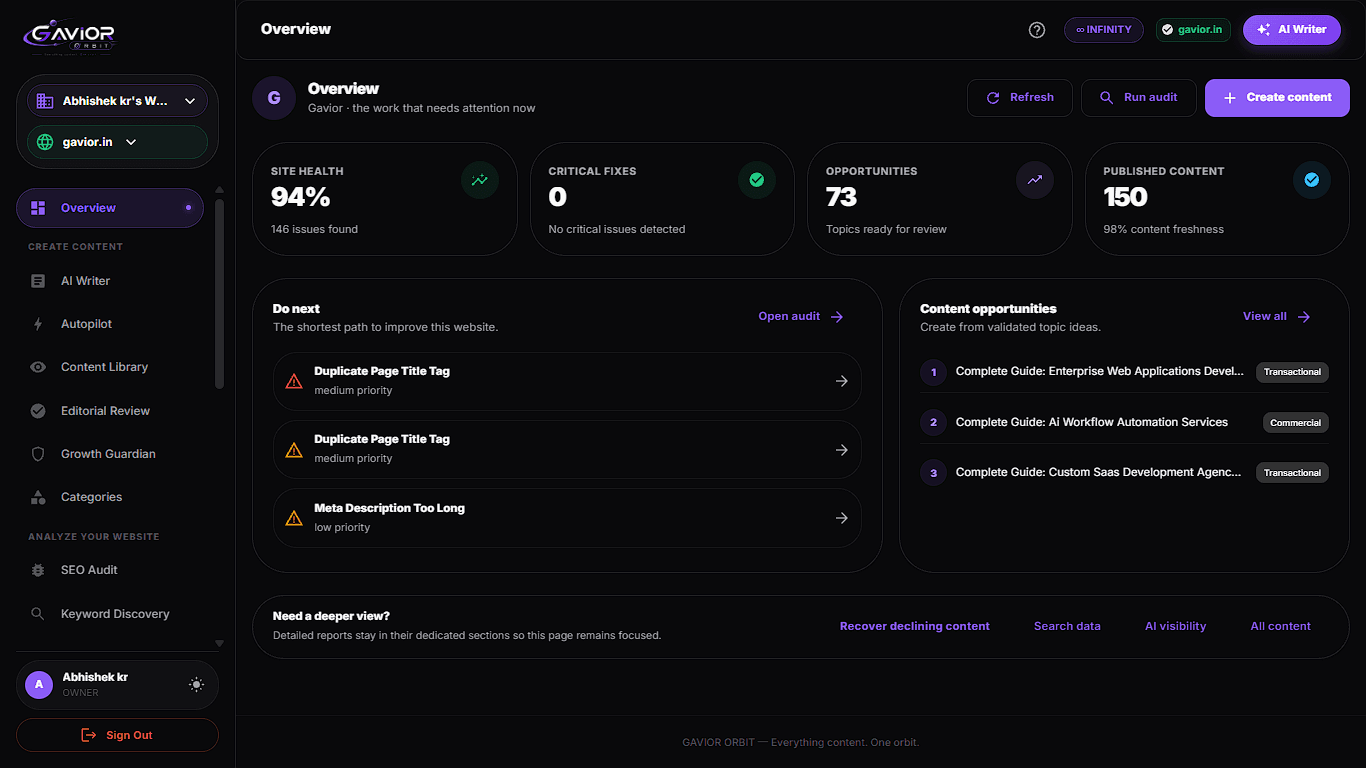
Our own product · Gavior OrbitA real Gavior Orbit interface. The captured figures describe a screen state; they are not performance tests, traffic growth or customer outcomes.
G
Gavior Editorial Team
Product and engineering editorial team at Gavior
The Gavior Editorial Team shares practical guidance on product design, software engineering, cloud delivery and AI automation.