
Gavior Orbit
A connected workspace for website audits, content opportunities, editorial review and publishing automation.
Automate a defined piece of work
Practical AI automations that connect the systems your team already uses. Begin with one measurable task, define review points and handle failures before expanding the workflow.
Explore the scopeBuilt around your goals. Scoped before we build.
Selected work
A connected workspace for website audits, content opportunities, editorial review and publishing automation.
A structured strategy builder that turns trading rules and configuration into editable Expert Advisor source code.
AI automation uses models alongside business rules and integrations to support tasks such as classification, summarisation and document processing. Gavior defines data access, review boundaries and evaluation criteria before deployment.
The scope
Your proposal defines what is included, how it will be reviewed and what your team receives. Here is what we can plan together.
Separate repeatable tasks from decisions that need judgement or additional data.
Connect approved sources and actions with validation, logging and human review where needed.
Check representative examples, failure paths, usage costs and operational ownership.
Where it fits
Different teams need different solutions. These are example starting points, not claims about past client outcomes.
Classify and summarise requests before routing them to the appropriate team.
Extract agreed fields and flag uncertain outputs for a person to review.
Draft summaries from authorised systems while keeping approval over publication or action.
From brief to handover
No black box. You can see the decisions, review the work and understand what happens next.
Define the current workflow, time spent, data inputs and acceptable mistakes.
Agree model access, sensitive data handling and which actions require approval.
Run representative examples and compare outputs against explicit acceptance criteria.
Deploy with failure handling, cost visibility and a named workflow owner.
Make an informed decision
Tell us the outcome, your current setup and the constraints. We will recommend a scope before you commit to a build.
Explore pricing & engagement optionsUse representative, appropriately anonymised examples for evaluation.
Confirm data-processing permissions and model-provider policies before connecting confidential information.
Selection depends on your requirements, existing systems and budget.
Before we begin
No. Deterministic rules or ordinary integrations are often better for predictable tasks. AI is useful where unstructured inputs need interpretation.
Only within deliberately agreed permissions. Payments, destructive changes or sensitive decisions may need human approval and an auditable record.
Validation, confidence handling and escalation should be designed into the workflow. A model's fluent output is not proof of correctness.
We examine task volume, model usage, retries and vendor pricing. Actual costs need monitoring after the pilot rather than a fixed savings promise.
Think connected
Plan with confidence
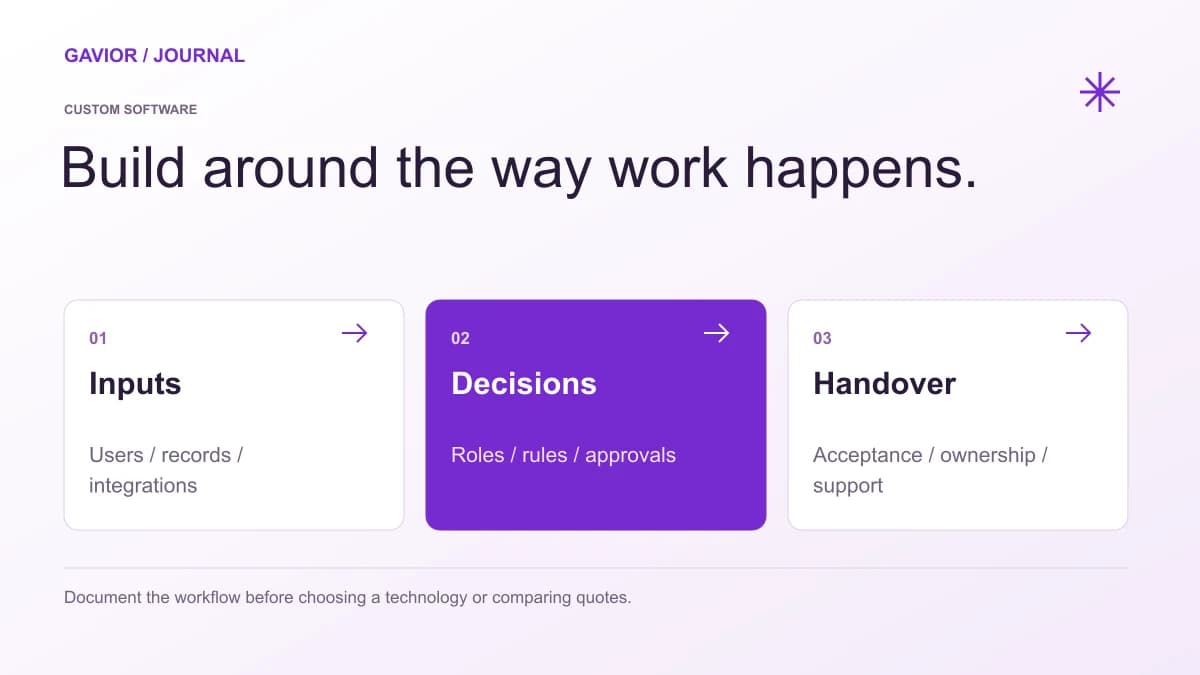 AI Automation
A practical way to choose the first workflow worth automating—without confusing a promising AI demo with a reliable business system.
TechnologyReal-world examples of how industry leaders use AI workflow automation to replace manual data bottlenecks with instant software execution.
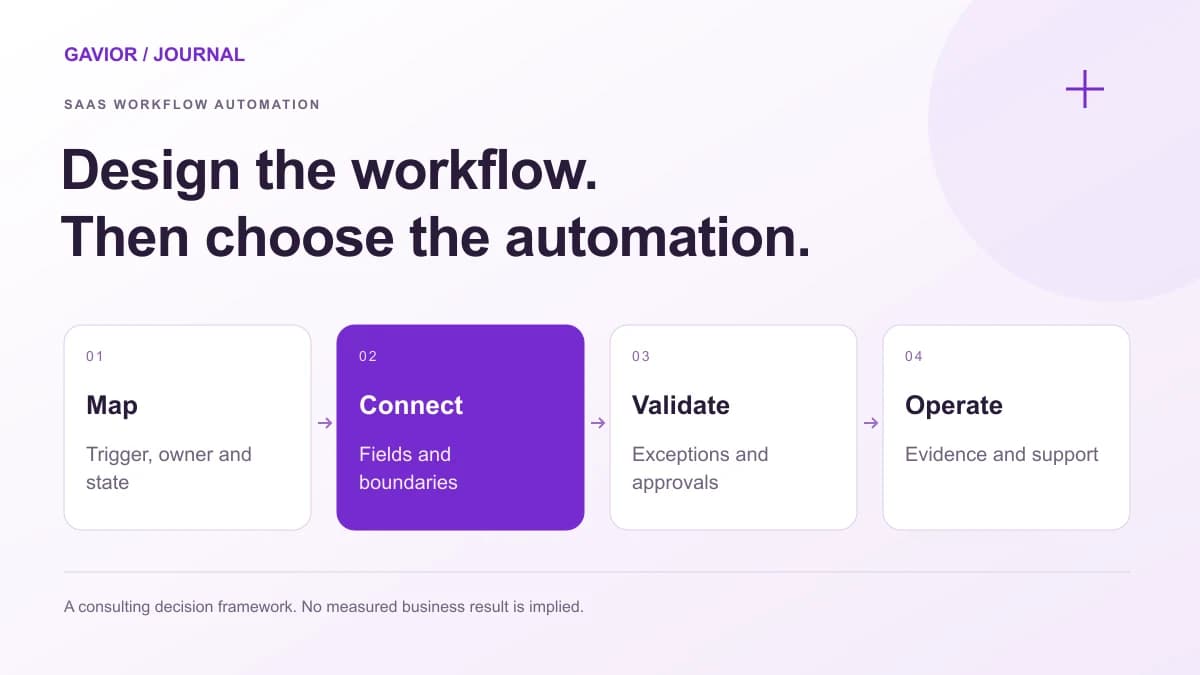 AI Automation
Plan SaaS workflow automation with clear ownership, integration contracts, exception handling and measurable acceptance checks. A practical guide from Gavior.
Let’s make it useful
A few focused questions. A clearer starting point for your project.