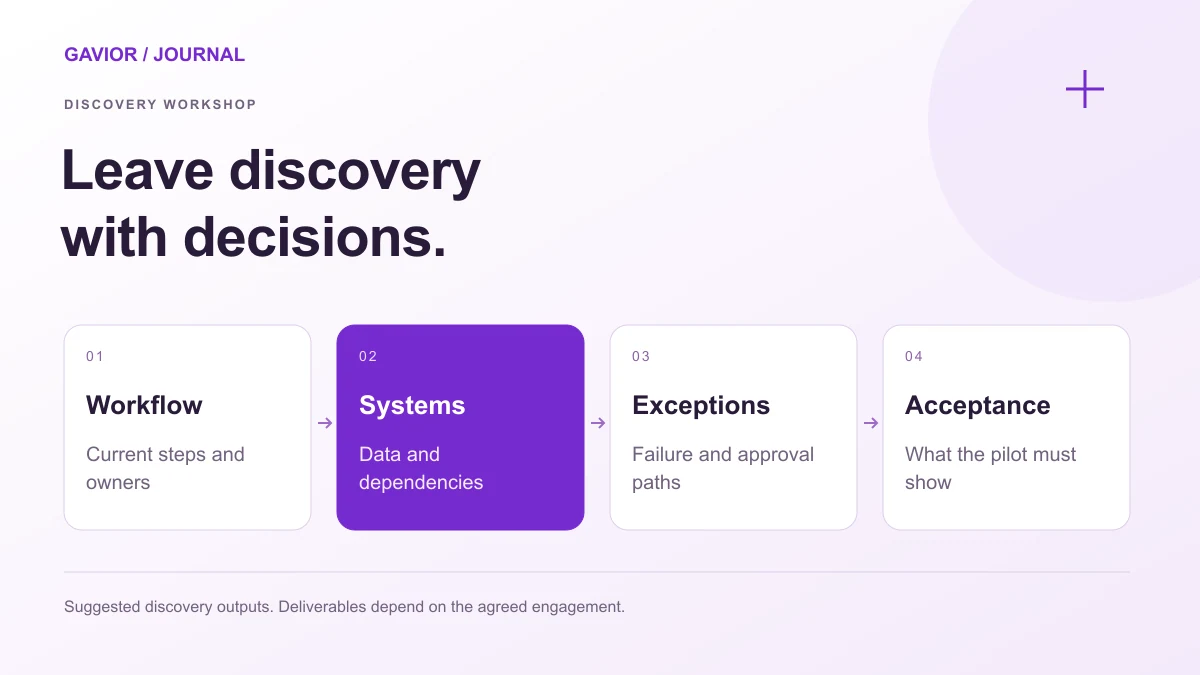
A SaaS automation discovery workshop turns a business process into an engineering brief. Its outputs should include a workflow map, decision boundaries, an integration inventory, named exception owners and acceptance evidence. These artifacts help a team decide what to build, what to keep manual and what needs investigation.
Gavior Editorial Team
Software and automation editorial team
Published: 2026-10-28Updated: 2026-10-28
Suggested discovery outputs. The actual scope and deliverables should be agreed before the engagement. View full-size image ↗
The important output is a set of decisions that operations and engineering can both inspect. A diagram labelled “CRM → AI → dashboard” leaves the difficult questions unanswered: which record starts the process, who can change it, and what happens when only part of the work succeeds?
Make your move
Ready to turn a better idea into a better business?
This checklist focuses on the workshop deliverables. If the candidate process is still unclear, first use the workflow selection framework to narrow the discussion.
Who should attend an automation discovery workshop?
Bring the person accountable for the business outcome, someone who performs the work, the owner of each affected system and an engineer who can evaluate integration constraints. Include a data or security reviewer when the proposed access needs their approval.
Ask the operator to bring redacted examples of normal work, incomplete requests, corrections and exceptions. A procedure document shows the intended process; examples reveal the decisions people actually make. Record unresolved differences rather than forcing the group to agree to a convenient but inaccurate diagram.
Assign a decision owner before the session. This person resolves business rules; the engineer checks whether the agreed rules can be implemented with the available interfaces. An agency should not invent operational policy to fill gaps in the brief.
What must the workflow map actually show?
Start with one trigger and one completion condition. Name each actor, system handoff, state change and approval. Separate waiting for a person from waiting for a system so that the team can identify the actual bottleneck.
For every step, record the input, output and evidence of completion. “Invoice processed” is ambiguous. “Approved invoice record saved with the supplier ID and approval reference” gives reviewers something specific to verify.
Use a comparison like this to check whether the proposed deliverables are usable:
Artifact
Too vague to approve
Reviewable workshop output
Workflow map
Automate monthly report handover
Trigger, actors, states and completion condition
Decision boundary
AI handles requests
Allowed actions, escalation rules and approval owner
Integration inventory
Connect the CRM
Objects, interfaces, access, limits and dependencies
Exception plan
Notify the team
Named queue owner, next action and escalation path
Acceptance evidence
System works correctly
Example inputs, expected states and failure checks
Record the current process separately from the proposed process. Otherwise, an undocumented policy change can slip into what appears to be a technical integration.
Which decisions can software make without approval?
Create a decision register with three groups: deterministic rules, suggestions requiring review and actions that remain manual. Name the owner who approves a rule and the evidence needed before changing it.
For example, a workflow can reject a request with a missing required identifier using a deterministic rule. A model may suggest a category for an ambiguous description. A contractual concession may still require an authorised person. Those are different decision types even when they appear on the same screen.
Do not use an undefined confidence score as the sole approval rule. Write down what happens when sources disagree, required evidence is absent or the model cannot provide a usable output. Specify what a reviewer can inspect and whether they can correct, approve or cancel the proposed action.
What belongs in the integration inventory?
For every connected service, record the account owner, object types, supported read and write operations, authentication approach, test environment and access approval. Add constraints that could change the scope, such as API availability on the customer's plan or missing historical records.
Confirm behaviour from the provider's documentation rather than assuming every API works alike. For example, Stripe's webhook documentation explains that events can arrive more than once and are not guaranteed to arrive in order. A workshop involving that integration should include repeat delivery and stale-event scenarios in its brief.
Where the process copies customer data between systems, the CRM and SaaS data sync checklist provides the field ownership and reconciliation decisions to add. Keep credentials out of workshop notes; record the access method and responsible owner.
Who owns incomplete work and exceptions?
Name an operational owner for each unresolved state. A shared inbox is insufficient unless someone is accountable for reviewing it and authorised to act. Decide what the operator should see, which action they can take and where the action is recorded.
Describe partial completion explicitly. If a customer record is created but a downstream task fails, should the workflow retry the task, pause for review or compensate for the earlier change? The answer depends on the business consequence.
Microsoft's compensating transaction guidance explains that reversing a multi-step operation can require business-specific actions and sometimes human intervention. The discovery output should identify those decisions before engineering selects a recovery mechanism.
What would a completed workshop brief look like?
Hypothetical example: A service business wants completed monthly reports to create review tasks in its customer portal. This is a planning example, not a Gavior client result.
The agreed trigger is a report changing to ready for review, rather than every document edit. The reporting system owns the report identifier and period; the CRM owns the client contact, and the portal owns the review task. An operations owner checks the draft task before the client is notified.
The brief records these acceptance cases:
A ready report creates one draft task for the correct client and reporting period.
A repeated delivery does not create another draft.
A missing client reference creates an exception assigned to the operations owner.
A revised report is linked to the existing task and explicitly marked for another review.
A failed downstream step remains visible and can be retried without repeating completed actions.
The team also records open questions, including how historical reports should be handled. An unresolved question becomes a dependency with an owner, rather than a hidden assumption inside the estimate.
How do you turn the outputs into an engineering scope?
Agree which workflow and exception paths belong in the first release. Attach the artifact versions, test examples, access dependencies and approval responsibilities to the proposed scope. Separate investigation work from implementation where an integration is still unverified.
Gavior can scope AI automation services around an agreed process and its operating controls. To discuss an automation discovery brief, bring the current workflow, affected systems, redacted examples and the person who can approve the business rules.
Frequently asked questions
Is an automation discovery workshop the same as an AI demonstration?
No. A demonstration shows a possible interaction. Discovery should produce agreed requirements, decision boundaries, dependencies, exception ownership and evidence the team will use to accept the implementation.
Do we need to choose an automation tool before discovery?
Usually the process and integration constraints should be clear first. An existing tool can be a constraint, but the workshop should establish the required behaviour before assuming a particular implementation.
Should every exception be automated in the first release?
No. Identify exceptions explicitly and agree which ones software handles. The remaining cases need a visible manual path, a responsible owner and enough context for that person to act.
What should Gavior receive before scoping the work?
Share the process goal, current steps, affected systems, redacted examples and approval owners. Note known access restrictions and open questions. These inputs help separate an implementable scope from assumptions that still require investigation.
G
Gavior Editorial Team
Software and automation editorial team at Gavior
The Gavior Editorial Team shares practical guidance on product design, software engineering, cloud delivery and AI automation.