
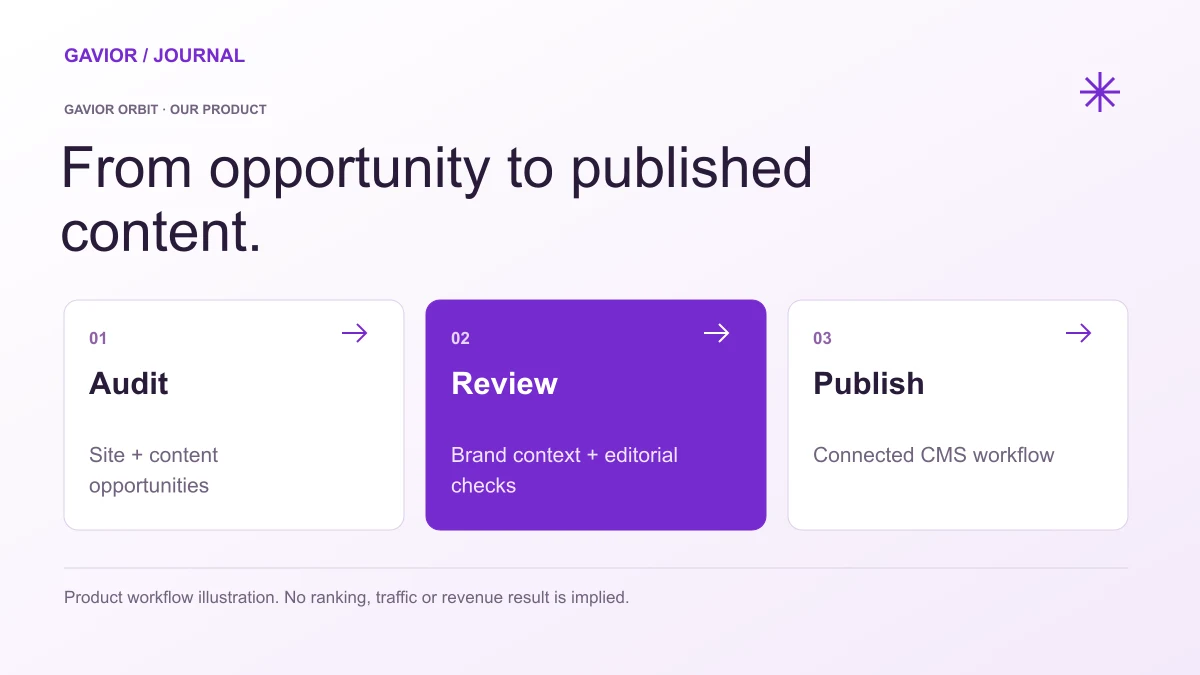
Switching from human-led retainer models to an Autonomous AI Content OS changes how growing enterprises scale search visibility, execute keyword clustering, and manage publishing. Traditional agencies rely on manual spreadsheets, disjointed writing teams, and slow feedback loops that stall organic traffic growth. Gavior solves these structural bottlenecks by integrating strategy, design, and proprietary workflow automation to deliver hands-off organic growth.
Key Takeaways
- Autonomous content operating systems remove manual bottlenecks by automating technical SEO audits, keyword clustering, and multi-CMS publishing.
- Traditional marketing agencies suffer from high overhead, slow content velocity, and subjective review bottlenecks.
- Human-in-the-loop controls ensure that automated output strictly preserves the brand voice and commercial outcomes.
- Scalability relies on integrated technology rather than linearly expanding human headcount.
The Structural Bottlenecks of Traditional Content Teams
Scaling organic traffic through a conventional marketing agency or an in-house writing team introduces friction. Human writers need extensive onboarding, weeks to research niche topics, and continuous editorial oversight. When companies scale publishing from four articles a month to forty, overhead costs scale linearly. Payroll expands, communication overhead rises, and content velocity drops significantly across distributed teams.
Furthermore, traditional teams struggle with technical synchronization. Content creators rarely execute technical SEO audits, keyword clustering, or context-aware internal linking without specialized SEO consultants. This fragmentation splits digital engineering from publishing strategy. Gavior bridges this gap by unifying technical infrastructure with automated content operations, ensuring web development and search visibility function as a cohesive, high-performing unit.
Agency retainers also create perverse economic incentives. Because human teams bill by the hour or charge steep monthly retainers regardless of output, clients often pay heavily for administrative overhead, meetings, and revision cycles rather than pure publishing volume or verifiable search traffic gains. This makes scaling cost-prohibitive for ambitious brands seeking rapid market penetration.
Many organizations also encounter severe scheduling bottlenecks when working with traditional agencies. Account managers act as intermediaries between clients and writers, introducing layers of bureaucracy that delay campaign execution by weeks. By contrast, an automated infrastructure removes these communication delays entirely, allowing digital engineering and publishing strategies to deploy in real time.
How an Autonomous AI Content OS Solves Scale and Speed
An Autonomous AI Content Operating System functions as an integrated software engine rather than a loose collection of standalone copywriting tools. It connects live SEO detection, semantic intent mapping, and multi-platform auto-publishing into a single pipeline. By operating directly with CMS environments like WordPress, Shopify, Webflow, and Ghost, the system removes manual copy-pasting and formatting delays entirely.
Content velocity increases from a trickle to a steady operational cadence. Technical SEO audits and keyword clustering execute continuously, identifying rank opportunities faster than human analysts reviewing static spreadsheets. Brands gain measurable efficiency gains, cutting operational expenses while multiplying content output across every relevant search vertical.
Unlike human teams that require rest, vacations, and ramp-up periods, an autonomous engine operates around the clock. It continuously monitors search landscape changes, updates internal linking structures via Orbital Mesh, and adapts to algorithm shifts without missing a publishing beat.
This relentless consistency transforms organic search into a predictable revenue channel. Rather than relying on sporadic bursts of content creation driven by quarterly freelancer availability, modern engineering teams can lean on structured workflows supported by AI Automation to maintain continuous market visibility.
Comparative Breakdown: Autonomous OS vs. Traditional Teams
Evaluating the shift requires looking closely at how each model executes core operational tasks across enterprise environments:
- Speed & Volume: Traditional agencies produce limited articles per month based on writer availability and rigid calendar schedules. An autonomous system maintains high content velocity without burnout or staffing constraints.
- Cost Structure: Agencies bill steep monthly retainers tied to billable hours and account management overhead. Software-driven automation scales output without proportional cost increases.
- Technical Integration: Content agencies rarely touch code or infrastructure. Autonomous systems tie directly into modern web frameworks, SaaS platforms, and custom digital engineering environments.
- Keyword Clustering & Architecture: Human teams manually group keywords in disjointed spreadsheets, missing semantic relationships. Automated engines map intent structures programmatically across entire catalogs.
When combined with core offerings like Web Development and AI Automation, these software-driven ecosystems provide companies with a complete competitive moat that traditional agencies cannot replicate.
Data-Driven Strategy and GEO Optimization
Modern search engines and AI-driven answer engines require more than basic keyword stuffing. They demand clear contextual structures, clean internal linking, and precise intent mapping. Autonomous content operations leverage data-driven strategies to structure long-form content for both traditional search and generative engine optimization (GEO).
By automating internal linking through systems like Orbital Mesh, authority flows naturally across web pages without manual hyperlink mapping. Decision makers gain predictable, hands-off organic growth that compounds over time, outperforming competitors stuck in manual content planning.
As search engines evolve into conversational answer engines, static keyword lists fail to capture user intent. An autonomous operating system continuously refines semantic clusters based on live search queries, ensuring that every published piece directly addresses what target audiences are asking at any given moment.
This technical rigor extends into Web App Development and overall digital infrastructure, ensuring that site speed, metadata handling, and crawlability remain optimized as organic content volume expands exponentially.
Human-in-the-Loop: Retaining Editorial Control
Automation does not mean surrendering control to an unmonitored algorithm. Review controls remain central to the workflow. Teams maintain absolute oversight through structured review checkpoints before anything reaches production.
This balance guarantees brand voice alignment. The engine drafts based on configured brand guidelines and verified keyword research, while human stakeholders approve final assets before auto-publishing to the CMS. Organizations get the speed of software automation combined with the precise strategic oversight required to protect enterprise reputation.
By keeping experts in the loop for final strategic sign-offs, companies eliminate the risk of hallucinated claims or misaligned messaging while retaining 90% of the operational efficiency delivered by the underlying software engine.
Frequently Asked Questions
Are traditional content agencies becoming obsolete?
Traditional agencies face severe pressure on speed and cost efficiency. While high-touch creative branding still requires human intervention, high-volume production, keyword clustering, and technical publishing are rapidly shifting toward autonomous software systems.
What are the cost savings of switching to an AI content operating system?
Switching replaces high-overhead monthly retainers and large writing teams with a software-driven model, drastically lowering the cost per published asset while scaling output.
How do autonomous content systems maintain brand voice?
They utilize strict configuration guidelines, domain-specific semantic training, and mandatory human-in-the-loop review steps to ensure every published piece reflects the exact brand tone.
What is the difference between an AI content generator and an Autonomous AI Content OS?
A standalone generator requires manual prompts, copy-pasting, and separate SEO tools. An Autonomous AI Content OS unifies live technical audits, keyword clustering, internal linking, and auto-publishing into one closed-loop system.
Ready to turn these ideas into results?
Move from insight to action with a solution aligned to your goals.