Business Website Content Checklist Before You Hire an Agency
Gavior Editorial Team
Design and engineering editorial team
Published: 2026-10-07Updated: 2026-10-07
Gather the service facts, proof, photos, legal details and customer questions that a website agency needs to build a useful business site.
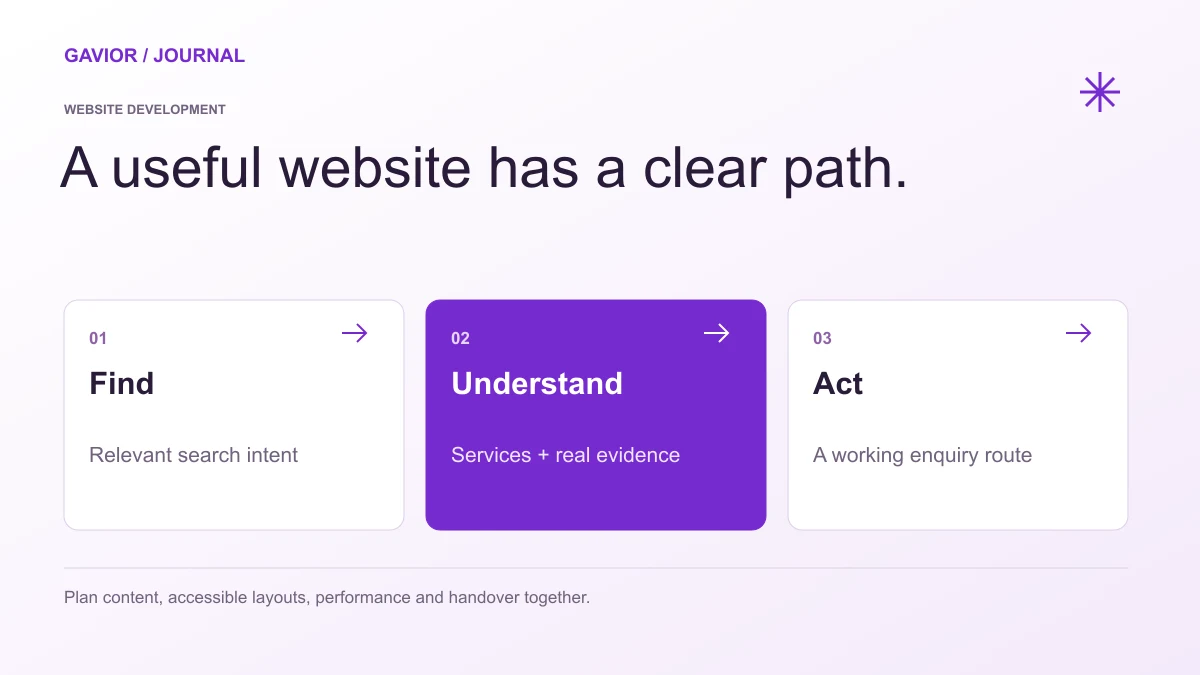
A website brief should connect content, user experience, delivery and ownership. View full-size image ↗
Many website projects wait on content, not code. The agency can build a page layout, but it cannot accurately describe your services, prices, policies or customer proof without your input. Preparing a small content pack before kickoff gives the team facts to work with and makes review much faster.
Make your move
Ready to turn a better idea into a better business?
What content do you need for a business website? At minimum, collect a clear offer, audience, service or product details, service area, contact information, photos you are allowed to use, and the customer action each page should support. Add proof, process, FAQs and policies where they affect a buying decision. You can ask an agency to write the copy, but you remain the source of truth for factual claims.
Build a source-of-truth folder
Use one shared folder with named owners and current versions. Do not send five conflicting brochures and ask the writer to guess which price is correct. A simple document with the date last verified is enough. Give the agency access to an approved brand kit and an inventory of any pages that must remain on the current site.
Content item
What to provide
Why it matters
Offer
Services, deliverables, exclusions and starting scope
Prevents generic claims
Audience
Buyer roles, common problems and service area
Shapes language and page structure
Contact route
Phone, email, form recipient and opening hours
Makes enquiries actionable
Proof
Approved projects, credentials and permitted testimonials
Supports trust without invention
Visuals
Logo, team or workplace photos, product images and usage rights
Avoids irrelevant stock imagery
Policies
Privacy, refunds, delivery or sector notices where applicable
Addresses practical and legal questions
Existing data
Search queries, top landing pages and frequent sales questions
Reveals what customers already need
For a local interior designer, useful specifics include service locations, project types, budget or package boundaries, how consultation works, design deliverables and real portfolio photography. “We make dreams come true” cannot replace those details. For a B2B software company, a buyer may instead need supported integrations, procurement steps, security contacts and a demo request route.
Prepare page-level notes, not polished prose
You do not need to write every final paragraph. For each proposed page, list the visitor's question, the factual answer and the next action. On a service page, that might be: who the service fits, what is included, what is excluded, typical process, what affects scope, and how to request a quote. A writer can turn those facts into concise copy while preserving accuracy.
Mark uncertain information explicitly. If pricing changes by project, say what determines a quote instead of inventing a universal number. If a case study lacks permission to name the client, describe the work without implying an endorsement. Do not borrow customer reviews or photographs from a source you cannot verify.
Ask real customers and sales staff
The most useful FAQ often comes from calls and inboxes. Ask your sales or support team which questions delay decisions. Are prospects unsure whether delivery is remote, whether maintenance is included, or whether they can update the site themselves? Put those answers close to the relevant service and conversion point.
Review search intent as well. A person looking for “restaurant website with online ordering” needs concrete ordering information, not a long general essay about web design. A person comparing agencies needs process, ownership, proof and next steps. Content should answer the page's specific task before adding marketing language.
Define an approval workflow
Choose one person to approve business facts, one to approve visuals and one final decision maker if possible. Set a review deadline and decide how comments will be resolved. A single marked-up document is easier to action than feedback spread across messages. The content team should flag any claim that lacks evidence before it goes live.
After publication, assign someone to update hours, staff names, prices and policies. A website is a continuing source of business information. The initial content pack should be easy to maintain.
Can the agency write everything from scratch?
An agency can research, interview and draft, but it still needs your validation of product facts and permissions. If copywriting is included, confirm how many pages, interviews and revision rounds the proposal covers. If you will supply finished copy, agree on word limits and formatting before design is locked.