Website Project Brief Template: What to Send a Developer Before You Ask for a Quote
Gavior Editorial Team
Design and engineering editorial team
Published: 2026-10-07Updated: 2026-11-07
Use this practical website brief template to explain your goals, audience, pages, content, integrations and launch constraints before requesting development proposals.
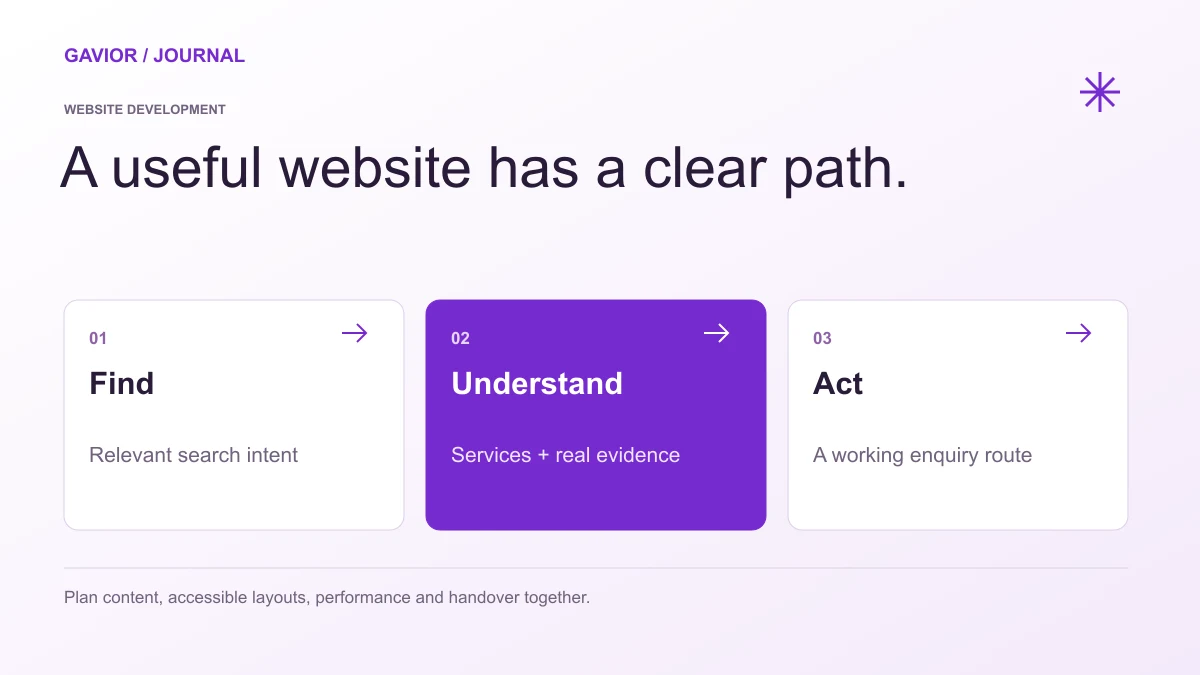
A website brief should connect content, user experience, delivery and ownership. View full-size image ↗
If you ask three website developers to “build a modern website,” you may receive three prices for three different products. A project brief makes the work comparable. It does not need technical language. It needs to describe the customers, the actions they should take, and the responsibilities you expect the development team to own.
Make your move
Ready to turn a better idea into a better business?
Short answer: A useful website project brief states the business goal, audience, page list, required features, available content, integrations, launch date, budget range and decision process. Include examples of what you like and dislike, but explain why. Developers can then identify missing scope before pricing the work.
Copy this website brief structure
Use the website development cost worksheet alongside this brief to compare build fees, recurring costs and acceptance responsibilities across suppliers.
Section
Write down
Example
Business and offer
What you sell and where you serve
“Commercial cleaning for offices in Pune”
Primary customer
Who makes the buying decision
“Operations managers at companies with 30–200 staff”
Deadline, approvals, accessibility or security needs
“Marketing manager approves copy; launch before trade event”
Success measure
What you can track after launch
Qualified enquiries and form completion
Start with the actual customer journey. For the cleaning company, visitors may arrive on a service page from search, check coverage and credentials, then request a visit. That path should shape navigation and calls to action. A design reference alone cannot explain it.
State what already exists
Tell the developer whether the domain, hosting, email, analytics and current website already exist. Identify the account owner for each. If the project is a redesign, say which URLs currently bring enquiries and which assets must be retained. If no website exists, say whether you have brand files, a logo, professional photos, service descriptions and customer approvals for any testimonials.
You do not need to know whether the site should use a particular framework or content management system. Describe the editing job instead: “Our team needs to update opening hours and publish one case study a month.” The provider can propose a suitable implementation and explain its tradeoffs. If you already depend on a particular platform or CRM, list it as a constraint.
Separate required scope from later ideas
Mark each item must have at launch, useful if budget permits, or later phase. A contact form that routes to the sales inbox may be essential. A logged-in client dashboard may be a separate product. This distinction helps a provider quote a focused first release instead of burying uncertain work inside a vague estimate.
For every must-have feature, write one observable acceptance test. For example: “A form submission from mobile reaches [email protected], records the source page and shows a confirmation to the visitor.” The exact inbox is illustrative; use your real destination. Acceptance tests prevent the familiar dispute in which a feature exists visually but does not support the business process.
Give useful budget and timeline information
A budget range helps a developer recommend an appropriate scope. It is not a request to spend the whole amount. If you cannot share a range, ask providers to price a defined minimum scope and optional additions separately. Say whether copywriting, photography, hosting, maintenance and tax must be included. State any real deadline and the reason for it; an arbitrary “ASAP” does not help plan reviews or content delivery.
Allow time for your own feedback. A ten-page site can stall because nobody approves copy, even if development is finished. Name one decision maker, the expected turnaround for reviews, and the person who can provide product facts.
Should you specify the technology in the brief?
Only if an existing system makes it a real constraint. Otherwise, describe what staff must be able to edit, which systems must connect, and what the website must do for visitors. Ask providers to justify their recommended stack in terms of ownership, maintenance and the required workflow.
Questions to send with the brief
Which requirements need clarification before you can quote responsibly?
Which deliverables, revision rounds and post-launch support are included?
Who owns the domain, code, design files, content and analytics accounts?
How will you test forms, mobile layouts, accessibility basics and search indexing?
What assumptions would change the timeline or price?
Send the same brief to every provider, then compare the assumptions in their replies. Our proposal comparison guide gives you a scoring method after the quotes arrive.
Ready to discuss it? Share your website brief with Gavior. Include the business goal, what already exists and any launch constraint. The form supports email follow-up; a WhatsApp number is needed only if you choose WhatsApp as your contact method. A rough first brief is enough to identify the next questions.
Client work · Website presentationA website from our client portfolio. Its presentation is not a price quotation or a claim about conversion results.
G
Gavior Editorial Team
Design and engineering editorial team at Gavior
The Gavior Editorial Team shares practical guidance on product design, software engineering, cloud delivery and AI automation.