One-Page vs Multi-Page Business Website: Which Should You Build?
Gavior Editorial Team
Design and engineering editorial team
Published: 2026-10-07Updated: 2026-10-07
Choose the right business website structure using service complexity, customer questions, search intent, content resources and future growth.
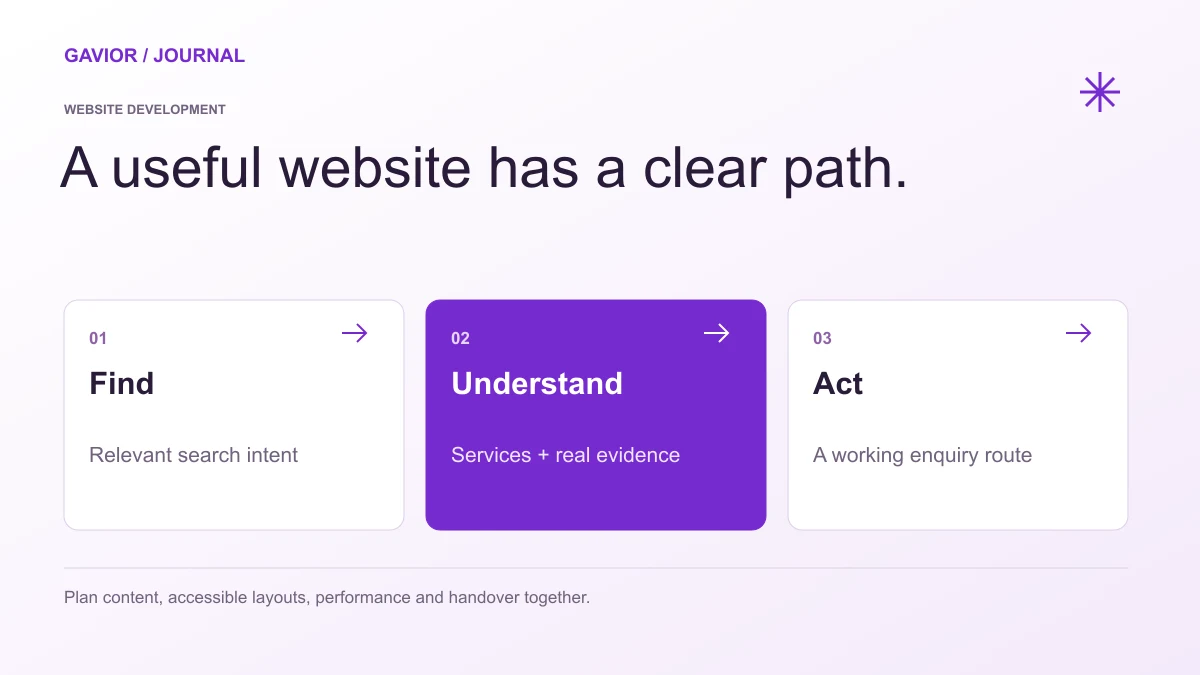
A website brief should connect content, user experience, delivery and ownership. View full-size image ↗
A one-page website can be a strong launch choice for a focused offer. A multi-page site gives different services and customer questions their own space. The decision should follow how people choose your business, not the number of pages in a template package.
Make your move
Ready to turn a better idea into a better business?
Short answer: Choose one page when the offer, audience and next step can be explained clearly in one flow. Choose multiple pages when services need separate explanations, different audiences search for different solutions, or the business needs substantial trust and support information. Either structure still needs mobile usability, clear contact routes and genuinely useful content.
Use this five-question decision test
Question
One page may fit
Multiple pages may fit
How many distinct offers?
One core service or a small set of closely related packages
Services solve different problems and need individual detail
How do people find you?
Mostly referrals, direct links or one clear search topic
Searches for several distinct service or location topics
How much proof is needed?
A compact portfolio and a few trust signals
Case studies, credentials, process and detailed answers
How often will content change?
Infrequent updates
Regular services, resources, locations or product updates
What is the conversion path?
One main action such as book a call
Different enquiries, bookings or purchases by service
Consider a freelance wedding photographer who serves one region. A concise page can show style, sample work, packages, availability and a contact form. Now consider a property services firm offering cleaning, pest control and repairs across several cities. Visitors have different questions and may need dedicated service pages before they contact the company.
What a good one-page site still needs
“One page” should not mean an oversized hero section and a generic form. A useful page states the offer, audience and service area early; shows specific work or evidence; explains the process; answers frequent objections; and offers a visible next step. Navigation can jump to sections, but the content should remain understandable without animation.
One page also has limits. A single title, main topic and URL must serve every subject on that page. If your services answer very different search intents, individual pages give each topic room for details, examples and relevant calls to action. Publishing dozens of near-identical thin pages is not a solution; a smaller set of substantive pages is easier to maintain.
How to plan a small multi-page site
A useful starting map for a service business is home, one page per meaningful service, about or approach, evidence or work, and contact. Add an FAQ when it answers real buying questions. Create a page for a location only when you can provide location-specific information and actually serve it. Your team should be able to maintain every page that launches.
Do not split content merely to increase the page count. If two short pages repeat the same promise and differ only in a city name, combine them or add material that truly serves those audiences. The website content checklist helps identify what information you already have.
Search and measurement considerations
Search visibility depends on relevance, content quality, technical accessibility and many factors outside the page count. A multi-page site can map distinct customer questions to distinct useful URLs. A one-page site can still be indexed and found for a focused topic. Neither structure guarantees a ranking.
Set up a basic measurement plan: which source brought the visitor, which page they viewed, and whether they contacted you. If visitors repeatedly ask a question your site does not answer, that is evidence for adding or improving a page. If a page gets traffic but few useful enquiries, revisit the message and call to action before adding more pages.
Can a one-page business website rank in search?
Yes, a focused one-page site can be indexed and appear for relevant queries. It has less space to answer several distinct topics thoroughly. If customers search for materially different services, useful dedicated pages usually make the information easier to find and understand. Page count by itself does not determine rankings.
Plan for growth without overbuilding
You can launch with a focused site and expand later. Ask the developer how new pages, navigation items and content edits will work. Keep the domain and analytics under your control. Agree on URL naming early so expansion does not require unnecessary redirects. A one-page site is a stage of the business, not a permanent commitment.