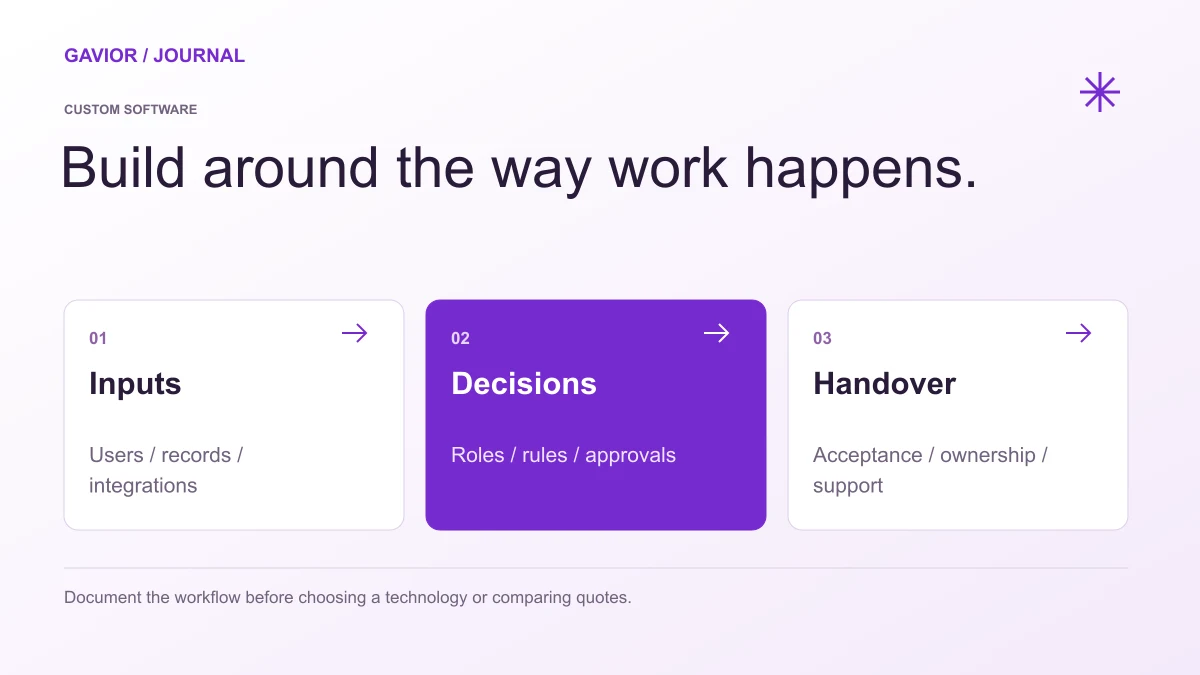
Buy an existing product when its standard workflow meets your important requirements and its operating terms are acceptable. Consider custom software when the workflow is a meaningful business differentiator or when essential requirements cannot be met responsibly through configuration. A combined approach can keep standard functions in established products while building only the missing layer.
Make your move
Ready to turn a better idea into a better business?
Gavior provides custom software development, so we have a commercial interest in this decision. A custom build is not automatically the right answer. This guide helps a buyer explain the choice before paying for a discovery phase or signing a subscription.
Describe the job before choosing the tool
Write down one complete journey: who starts the task, which information is needed, who approves it and what a successful outcome looks like. Include exceptions. “We need a dashboard” describes a screen; “dispatchers need to resolve delayed deliveries without searching three systems” describes a business job.
Separate essential requirements from preferences. An unfamiliar button position may be a training issue. A missing approval boundary that allows the wrong employee to authorise a payment is a substantive gap. Ask the team to show actual examples of each problem rather than creating a feature list from memory.
Compare three realistic options
Option
Worth investigating when
Question to resolve
Existing SaaS with configuration
The core process is common and supported
Can the vendor demonstrate your difficult cases?
Custom application
The important workflow cannot fit the available products
Who will maintain it after the first release?
Existing tools plus a custom integration
Standard tools work, but handoffs cause friction
Can the integration recover safely when one system fails?
Do not compare a ready-made product against an imagined custom application with every desirable feature. Compare defined scopes, a credible delivery plan and the responsibilities each option leaves with your team. A short prototype can help resolve uncertainty, but it is not proof that an entire production system is complete.
Test fit with a scripted demonstration
Give vendors the same scenarios. Include a normal transaction, an incomplete request, a changed approval, a failed integration and a user with limited permissions. Ask them to show the behaviour rather than answer “yes” to a spreadsheet. Record whether the outcome requires configuration, a paid extension, manual work or unsupported customisation.
For a hypothetical wholesaler, the test might be: a sales representative creates a draft order, a manager approves an exception to the agreed terms, and warehouse staff see only the fulfilment fields they need. This is an illustrative scenario, not a Gavior client result. Replace it with your own process and sample data.
For a construction estimating workflow, the BOQ software requirements checklist gives another illustrative test boundary: quantities, approved rates, revisions and an issued export. It can help compare an existing product with a custom build against the same required behaviour.
Count the operating obligations
Estimate costs over a period meaningful to your business, using written assumptions. For SaaS, consider subscriptions, user tiers, integration allowances, onboarding, data migration and specialist administration. For a custom build, include discovery, design, engineering, hosting, monitoring, security maintenance, support and future changes. Neither category becomes free after launch.
Identify the owner of each obligation. Someone must manage user access, correct bad source data, approve changes and answer operational questions. Ask what happens when the original developer or internal project owner leaves. A system can be inexpensive to purchase but difficult to operate if these responsibilities have no named owner.
Check data access and the exit route
Ask to see the export format, attachments, identifiers and relationships that would be available if you leave. Confirm which integrations are supported and what access is included in the proposed plan. For custom work, document repository access, deployment ownership, third-party dependencies and the scope of transferred rights in the agreement.
Use a small export and import exercise where possible. A promise of “full data ownership” is less useful than proving that the business can obtain a readable, complete copy of its own records. Legal and licensing questions should be resolved against the actual contract rather than assumed from the technology choice.
Make the decision explicit
Create a one-page decision note with the required workflow, options considered, unresolved risks, estimated operating obligations and the reason for the preferred approach. Identify what evidence would change the decision. If there is no clear advantage to custom software, buying and configuring an existing product may be the sensible next step.