Scope custom BOQ software around quantities, rates, revisions and approvals. Use the checklist to compare development proposals and acceptance checks.
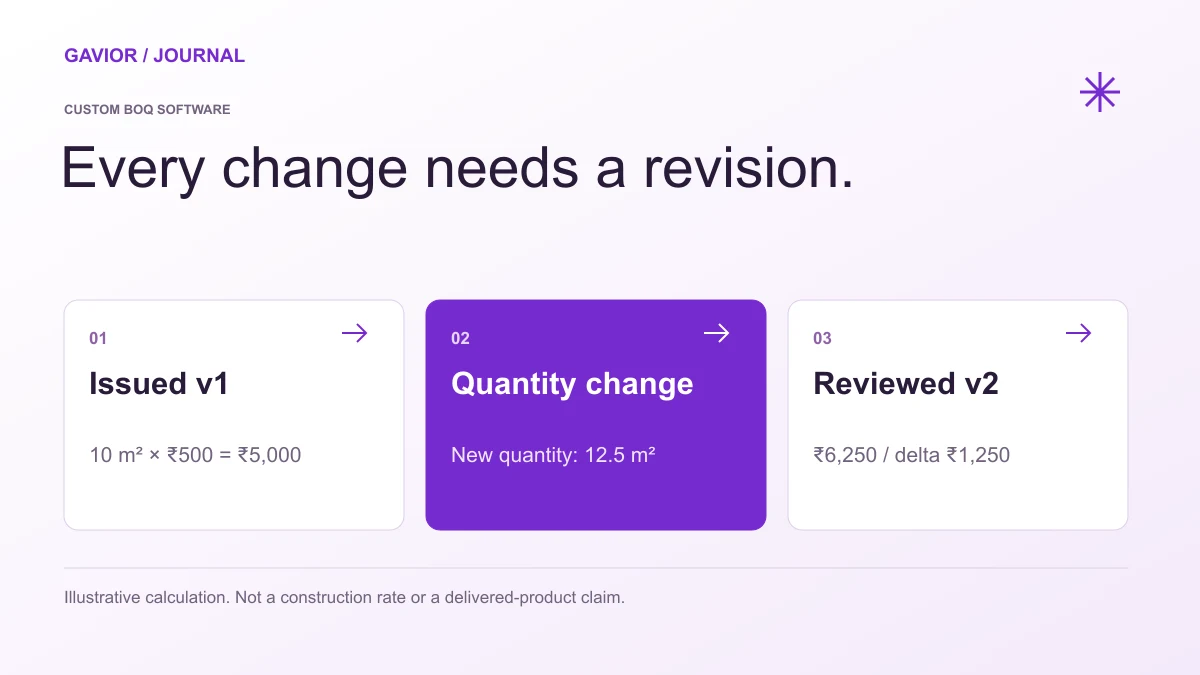
Example inputs only: ₹5,000 becomes ₹6,250 after an approved quantity revision. View full-size image ↗
Custom BOQ software should connect bill-of-quantities items, units, quantities, rates, revisions and approvals into a traceable workflow. Before commissioning development, define who supplies measurement rules, who can change commercial data and how an issued version is preserved. Evaluate a supplier against these requirements and demonstrated acceptance checks.
Make your move
Ready to turn a better idea into a better business?
Gavior scopes custom business software. Bring an existing spreadsheet, representative BOQ and approval process to discuss a development brief. The workflow below is illustrative; it is not a claim that we have delivered this particular construction system or a substitute for a quantity surveyor's measurement decisions.
What business workflow should the software support?
Start with the process from receiving project information to issuing an approved BOQ or quotation. Identify the people, documents and revision decisions involved. A table that multiplies quantity by rate is only one part of that process.
For an illustrative contractor workflow, an estimator imports approved items, checks units and quantities, applies an authorized rate set and sends a draft for review. A commercial manager approves an issue. Later changes create a new revision rather than silently changing the version already sent to a customer.
If the business needs drawing take-off, procurement, tender comparison or invoicing, name each as a separate scope decision. Do not assume those capabilities are included merely because the proposal uses the term "construction software". The build-versus-buy guide can help determine whether an existing product already fits the workflow.
Which data definitions need agreement first?
Agree item identity, descriptions, units, quantity precision, rates and revision behaviour before designing screens. Have the business's estimator or commercial owner supply the applicable measurement and pricing rules, including rounding and any approved adjustments.
RICS publishes New Rules of Measurement, including NRM 2 for detailed measurement of building works. This is one reference a project team may use; it does not establish which measurement convention applies to your project. The brief should name the customer's chosen rules and responsible reviewer.
Data area
Requirements to settle
Project and work breakdown
Projects, locations, packages and item grouping
BOQ item
Stable identifier, description, unit and source reference
Quantity
Precision, permitted inputs and measurement owner
Rate
Currency, effective version, edit permissions and source
Adjustment
Approved handling of discounts, markups or other specified factors
Revision
Draft, reviewed and issued states with a change history
Output
Required spreadsheet, PDF or downstream-system fields
Distinguish a changed description from a changed commercial value. If imports must preserve an existing item identifier, document that mapping instead of relying on row position in a spreadsheet.
What should a calculation and revision example prove?
Use a small, business-approved example that the receiving team can independently verify. Record the source inputs, expected line values, totals, rounding and the effect of a revision. This makes the acceptance discussion concrete.
In this illustrative example, an item has a quantity of 10 square metres and a rate of ₹500 per square metre. Its line amount is ₹5,000. A later approved quantity of 12.5 produces ₹6,250 at the same rate, a difference of ₹1,250. These are sample test inputs, not current construction rates or a Gavior software price.
The software should retain the original issued version according to the agreed revision policy. The new quantity, reviewer, approval and output need a traceable connection. Confirm how rounding is applied across multiple lines before accepting a report that only matches one simple multiplication.
Which acceptance checks should a buyer request?
Request demonstrations of valid work, rejected inputs, permission boundaries and repeat operations. The checks should use representative customer data with appropriate permission and expected results approved by the business owner.
Situation
Acceptance evidence
A file contains an invalid or missing unit
The import identifies the affected item without silently accepting the wrong meaning
A file is imported again
The defined duplicate or update behaviour is applied
An estimator edits an issued item
The agreed revision and approval policy is enforced
A user lacks rate-editing permission
The server rejects the change, not only the screen control
An approved quantity changes
The revision shows the before/after values and expected totals
A BOQ is exported
Identifiers, units, values and totals match the approved version
An operator restores a backup
The agreed records and attachments can be recovered and reviewed
Define project access separately from commercial permissions. A user may be allowed to view a project's quantities without being allowed to edit rates or issue a quotation. If multiple customer organizations share an application, add a tenant-isolation review.
What belongs in the estimate and handover?
The development proposal should separate the core BOQ workflow from data cleanup, migration, drawing tools, integrations, custom report formats and ongoing support. State the representative dataset and approval availability used for the estimate.
Ask who owns project records, rate libraries, exported files, source access and hosting accounts. Agree the operating documentation and how a new internal user will be trained. For a multi-organization product, the SaaS scope guide helps define the wider customer and administrator journey.
Price uncertainty explicitly. An unreviewed legacy spreadsheet or undocumented accounting integration may require assessment before a build milestone can be committed. A supplier should explain that boundary rather than treating every later discovery as a surprise change.
Frequently asked questions
Is a BOQ application the same as a complete ERP?
No. A BOQ application can focus on quantities, pricing and approvals. Procurement, inventory, accounting, payroll and other workflows are separate requirements unless the agreed scope includes them.
Can we start with our current spreadsheets?
Yes. Provide representative files, formulas, units, revision examples and known exceptions. Review which rules are intentional before turning spreadsheet behaviour into application requirements.
Who should approve measurement and pricing rules?
Assign a qualified business reviewer responsible for the project's measurement and commercial decisions. The development team implements and tests those approved rules; it should not invent construction quantities or rates.
What should we ask a BOQ software company to demonstrate?
Ask for a complete representative journey from import through review and approved export, including a revision and a rejected unauthorized edit. Evaluate the result against your documented workflow, not only a polished dashboard.