
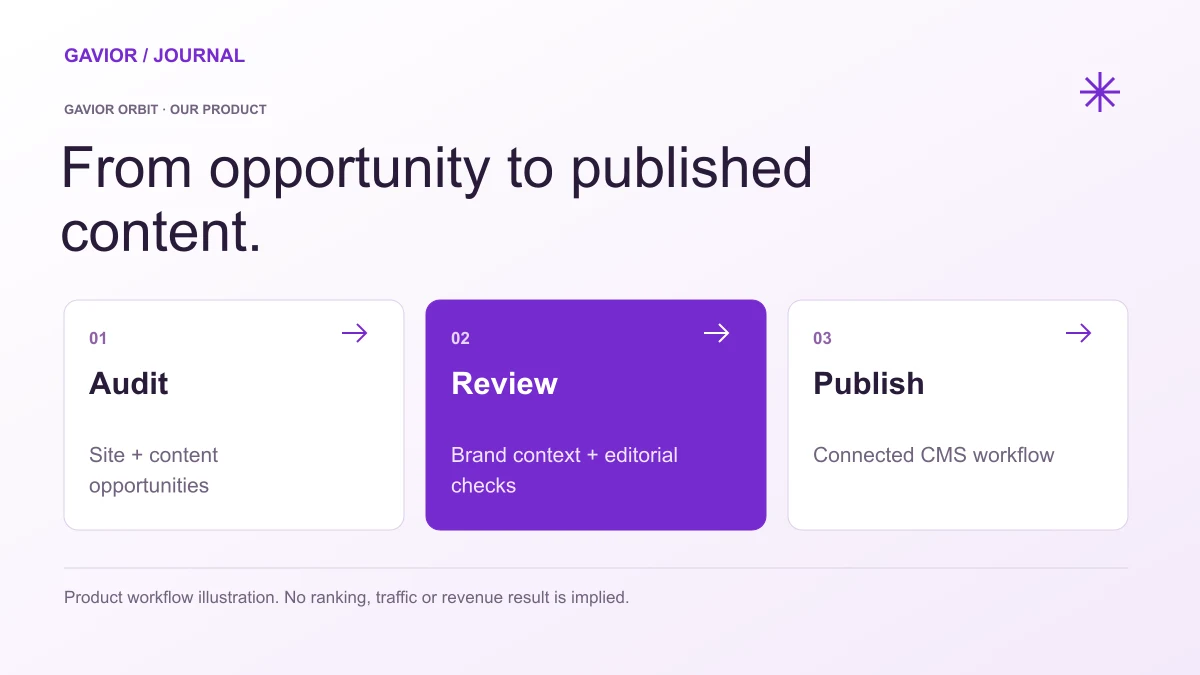
An autonomous AI content and SEO engine is an integrated software system that unifies automated technical site audits, semantic keyword clustering, intent-driven generation, context-aware internal linking, and direct multi-platform CMS publishing into a single closed-loop architecture. Designed for ambitious enterprises, technology startups, and digital brands, this infrastructure eliminates the manual bottlenecks of traditional editorial production lines by treating organic search as an automated engineering pipeline rather than a fragmented marketing chore. Gavior engineers this capability directly through Gavior Orbit, bridging custom Web Development and enterprise-grade AI Automation to turn organic search into a scalable software asset.
- An autonomous AI content OS replaces brittle plugins and disconnected editorial spreadsheets with unified, API-driven workflows.
- Automated technical SEO crawler routines run persistent site audits to catch crawl errors, broken directives, and schema gaps in real time.
- Orbital Mesh establishes a context-aware internal linking engine that calculates semantic relevance to direct authority flow cleanly across deep hierarchies.
- Orbital Echo operates as an enterprise AI content repurposing system, translating core pillar assets into multi-channel formats without manual drafting.
- Strict adherence to the Google Helpful Content System and algorithmic Information Gain Scores prevents generic synthetic spam penalties.
The Architectural Flaws of Traditional Toolchains
Scaling organic search through legacy methods is fundamentally broken. Most growing businesses assemble an unstable patchwork of tools: one subscription for keyword discovery, another for rank tracking, separate desktop applications for technical crawling, and third-party plugins grafted onto monolithic CMS platforms. Each step requires human intervention to export CSV files, parse search volumes, write outlines, paste drafts into rich text editors, and manually insert hyperlinks. This disjointed workflow drains developer bandwidth and leaves marketing teams stuck in low-velocity release cycles.
The technical debt behind this setup is severe. Traditional WordPress plugins run database queries on page load, bloat server response times, and frequently break during core CMS updates. Meanwhile, freelance writing networks and fragmented content teams struggle with technical nuance. They produce generic copy that lacks original research and fails basic Search Intent Analysis. When technical optimization and publishing exist in disconnected silos, websites inevitably suffer from orphan pages, broken redirects, and compounding content decay.
True operational efficiency requires abandoning manual editorial handoffs entirely. Just as modern engineering teams shifted from manual server provisioning to continuous integration and automated deployment, search acquisition requires a shift toward an autonomous AI content OS that executes technical tasks, content modeling, and distribution as automated background services.
Core Capabilities of an Autonomous Content OS
An autonomous growth platform does not merely string together generic API calls to Large Language Models (LLMs). It functions as a resilient software platform with purpose-built microservices operating across every tier of technical search optimization:
- Automated Technical SEO Crawler: Runs continuous, headless inspections across your domain to audit HTTP status codes, core web vitals, canonical parity, robots directives, and rendering bottlenecks. It detects crawling failures long before search engine bots do.
- Semantic Keyword Clustering: Replaces superficial exact-match targeting with Natural Language Processing (NLP) models that group thousands of long-tail search queries into unified topical clusters. This ensures comprehensive topic coverage while eliminating internal keyword cannibalization.
- Programmatic SEO & Schema Markup Automation: Generates structured data graphs (JSON-LD) dynamically for every content entity. Breadcrumbs, tech articles, software applications, and FAQ schemas are applied systematically across the codebase without manual template adjustments.
- Context-Aware Internal Linking Engine: Powered by Gavior Orbit's Orbital Mesh, this module analyzes vector embeddings across your complete publishing index. It identifies relevant textual anchors and establishes bidirectional authority corridors automatically, eliminating dead ends and spreading page authority throughout complex site architectures.
- Content Decay Monitoring: Tracks post-indexing search performance and flags decaying rankings, outdated technical examples, or shifting search intent, automatically queueing assets for algorithmic refreshes.
Comparing Traditional Workflows vs. Autonomous AI Engines

Moving from manual content production to autonomous digital engineering fundamentally alters speed, cost profiles, and operational reliability.
| Operational Dimension | Traditional Content & SEO Stack | Autonomous AI Content OS (Gavior Orbit) |
|---|---|---|
| Site Audits & Health | Periodic manual scans via third-party desktop tools | Automated technical SEO crawler with continuous monitoring |
| Keyword Research | Static spreadsheets, search volume guesswork | Semantic Keyword Clustering using real-time intent mapping |
| Internal Linking | Manual author hyperlinks; brittle, ad-hoc execution | Automated, context-aware internal linking engine (Orbital Mesh) |
| Content Production | Multi-week manual editorial cycles prone to bottlenecks | Autonomous Content Generation with technical domain grounding |
| Multi-Channel Reach | Manual rewriting for social platforms and email lists | Multi-channel AI content repurposing engine (Orbital Echo) |
| CMS Distribution | Copy-pasting between documents and CMS fields | Native API webhooks to WordPress, Shopify, Webflow, and Ghost |
Algorithmic Integrity and the Google Helpful Content System
Automating content creation introduces an essential quality challenge: search engines aggressively demote shallow, repetitive synthetic text. Pumping out hundreds of unverified pages using basic chat prompts is a direct path to algorithmic devaluation. Autonomous engines must be engineered from the ground up to respect the Google Helpful Content System and Search Engine Optimization (SEO) quality standards.
Gavior Orbit avoids generic model hallucinations by enforcing rigorous information verification layers. Every generated asset is measured against an internal Information Gain Score. This ensures the output supplies practical code snippets, verifiable system architectures, structured tables, or fresh analytical angles that do not simply regurgitate top-ranking search engine results pages.
Furthermore, an enterprise autonomous engine should maintain flexible Human-in-the-Loop (HITL) review gates. Technical teams and product leads can inspect generated drafts, verify code samples, and approve publishing queues through automated staging environments before production webhooks trigger. This protects domain reputation while preserving exceptional publishing throughput.
Expanding Distribution via Multi-Channel Content Repurposing
Publishing an authoritative technical guide on your core website is only half the battle. Modern audiences consume information across multiple touchpoints, yet manually repackaging technical long-form articles into platform-appropriate snippets exhausts internal resources. This operational gap is why an enterprise AI content repurposing tool is vital to modern growth architecture.
Through Gavior Orbit's Orbital Echo, the engine processes structured pillar articles and automatically extracts core concepts, transformation summaries, technical checklists, and executive excerpts. It reformats long-form prose into native multi-platform assets tailored for developer communities, email briefings, and social channels. Because all derived content shares the same technical foundation, your brand projects authoritative messaging across the entire web without requiring dedicated copywriters to rewrite the same ideas from scratch.
Practical Engineering Roadmap for Autonomous SEO Deployment
Transitioning your business to an autonomous search infrastructure requires a deliberate, step-by-step rollout across your engineering and growth stacks:
- Infrastructure and CMS Audit: Audit current site infrastructure, page load speeds, and API support across your publishing layer. Whether your stack uses custom Next.js builds, Webflow, Shopify, Ghost, or headless WordPress, verify endpoint authentication and webhook access.
- Taxonomy and Semantic Map Setup: Define core commercial categories, primary product boundaries, and high-value search queries. Feed these parameters into semantic clustering algorithms to produce non-overlapping topical clusters.
- Automation Configuration: Deploy programmatic schema generation rules, configure automated technical SEO crawler schedules, and connect your internal linking mesh parameters to prevent orphan page development.
- Governance and Webhook Activation: Set quality thresholds, define human review staging steps, and configure multi-channel repurposing pipelines to distribute validated content on autopilot.
By treating search optimization as an integrated software system backed by modern Web Development and robust AI Automation, businesses escape manual publishing bottlenecks and secure compounding organic search authority.
Frequently Asked Questions
What is an autonomous AI SEO engine and how does it work?
An autonomous AI SEO engine is an integrated software system that manages the entire organic search lifecycle through automated pipelines. It combines an automated technical SEO crawler, semantic keyword clustering algorithms, intent-driven generation models, context-aware internal linking, and direct CMS publishing via APIs to execute organic search strategy without manual operational friction.
What is the difference between an AI writing assistant and an autonomous SEO engine?
An AI writing assistant is an interactive text prompt tool that requires a human user to manually outline, prompt, edit, format, and publish individual blog posts. An autonomous AI content engine functions as a full operating system. It audits site architecture, identifies ranking gaps, optimizes internal authority flow, updates structured data, and pushes production-ready assets directly to your CMS automatically.
How do autonomous AI engines maintain quality and prevent hallucination?
Advanced autonomous engines integrate verified source grounding, Information Gain Scoring, and Human-in-the-Loop governance gates. Instead of producing unchecked synthetic text, the engine verifies technical claims, enforces schema markup automation standards, and aligns every draft with the Google Helpful Content System guidelines before deployment.
Can fully automated AI content rank reliably on Google?
Yes. Search engines prioritize relevance, accuracy, originality, and technical structure over the specific drafting mechanism. When automated content incorporates verified factual analysis, matches search intent, avoids unoriginal summarization, and lives on an engineered foundation with proper schema and clean internal linking, it builds durable topical authority that ranks consistently.
Ready to turn these ideas into results?
Move from insight to action with a solution aligned to your goals.