
AI workflow automation services replace manual data bottlenecks and rigid off-the-shelf software with intelligent, custom execution engines designed for modern enterprises. By combining secure cloud infrastructure, API connectivity, and specialized machine learning models, growing businesses can automate complex operations without sacrificing data security and compliance. Through tailored architectures, enterprises eliminate repetitive drag, unify disparate data streams, and establish predictable software execution.
- Start with workflow evidence and concrete automation scorecards rather than generic software demos.
- Implement rigorous human controls and boundary mapping before AI touches consequential business decisions.
- Leverage cloud infrastructure like AWS and Azure to scale computational resources efficiently.
- Calculate total cost of ownership (TCO) across custom LLM deployment, model drift monitoring, and ongoing maintenance.
The Economic Reality of Legacy Bottlenecks
Legacy systems and brittle monolithic software force teams into repetitive manual tasks that drain operational velocity. Enterprises frequently struggle with data silos, slow response times, and disconnected applications that fail to scale with commercial demand. Relying on basic robotic process automation often hits a wall when unstructured documents, natural language processing requirements, or nuanced customer queries enter the pipeline.
Integrating purpose-built business process automation bridges this divide. Instead of forcing your team to adapt to rigid software limitations, custom architectures encode proprietary workflows into intelligent agents. This approach cuts down repetitive tasks by 10 to 30 hours per week while dramatically reducing human error across customer support and data processing. Engineering teams no longer patch together temporary scripts; instead, they deploy resilient software systems designed for long-term scalability.
When modern organizations look to modernize their digital presence, they often discover that frontend web properties and backend operations must evolve simultaneously. Combining high-performance Web Development with intelligent backend routing creates a unified digital ecosystem that minimizes friction for both internal teams and end users.
Core Components of Modern AI Workflow Automation Services
Building high-performance automation requires more than plugging into a public API. A resilient enterprise deployment relies on distinct foundational layers working in concert to handle enterprise workloads reliably across distributed environments.
1. Custom LLM Deployment & Fine-Tuning
Off-the-shelf models often lack the contextual awareness needed for industry-specific data. Custom LLM deployment involves training models on proprietary datasets, enabling precise contextual awareness for financial services, legal documents, or complex bill-of-quantities parsing. This ensures outputs match the strict vernacular and factual requirements of your industry without relying on generic web-scraped assumptions.
2. Secure API Connectivity & System Integration
Data must flow cleanly between CRM platforms, ERP systems, and external databases. Robust API connectivity ensures secure, real-time data exchange without introducing vulnerabilities into your core cloud infrastructure. Whether connecting legacy databases to modern web applications or synchronizing multi-tenant SaaS environments, clean integration protocols eliminate synchronization lag.
3. Predictive Analytics & Business Intelligence
Modern automation systems do more than execute repetitive tasks. They extract insights from large datasets, generate predictive analytics, and surface actionable intelligence that helps leadership teams make faster commercial decisions. By turning raw operational logs into structured insights, organizations spot market trends and internal friction points before they impact revenue.
Evaluating Workflows Before You Automate
Not every process deserves an AI agent. Selecting the right workflow requires strict evaluation of operational friction and financial return. Teams should audit customer support ticketing systems, email routing, lead qualification pipelines, and document processing tasks before writing code.
For instance, customer support AI chatbots and intelligent ticketing systems handle tier-one inquiries instantly, freeing human agents to resolve complex escalations. Similarly, automated lead qualification instantly scores and routes incoming inquiries based on predefined criteria, ensuring sales teams focus exclusively on high-value prospects.
When assessing organizational readiness, leaders must weigh the total cost of ownership (TCO). This includes upfront engineering hours, API consumption costs, and ongoing model maintenance. A rigorous assessment prevents wasted capital on glamorous but impractical AI initiatives, focusing instead on high-yield business process automation.
Balancing Autonomous Execution with Human Oversight
Autonomous systems require clear control boundaries, particularly in regulated industries like financial services. Before deploying custom workflows, engineering teams must map the control boundary to define where AI operates autonomously and where mandatory human approval is triggered. Establishing robust monitoring mitigates model drift, unexpected hallucinations, and compliance breaches.
Gavior combines rigorous software engineering with structured AI Automation to help enterprises transition away from brittle legacy frameworks. Whether you are building scalable SaaS platforms, modern web applications, or integrating advanced AI workflow automation services, our technical team aligns infrastructure directly with your commercial outcomes.
Beyond backend automation, maintaining visual and digital consistency across digital touchpoints remains critical. Organizations often pair backend engineering workflows with professional Graphic Design and Video Editing to ensure that automated customer-facing portals and media assets maintain uncompromised aesthetic standards.
Frequently Asked Questions
What is the difference between traditional automation and AI workflow automation?
Traditional automation follows strict, predefined rule sets and fails when encountering unstructured data. AI workflow automation uses natural language processing and machine learning models to interpret variable inputs, parse unstructured documents, and make contextual decisions.
How long does it take to implement AI automation in a business?
Implementation timelines vary based on system complexity, data cleanliness, and integration requirements. Scoping begins with workflow evaluation and control boundary mapping before moving into custom development and testing.
What types of business processes are best suited for AI automation?
Repetitive, data-heavy tasks with digital footprints—such as customer support ticketing, email categorization, document extraction, invoice parsing, and lead qualification—yield the highest immediate operational ROI.
How much do AI workflow automation services typically cost?
Costs depend on custom LLM requirements, RAG pipeline complexity, third-party API integrations, and ongoing monitoring needs. Transparent pricing structures evaluate scope, infrastructure overhead, and expected development timelines prior to execution.
Practical Implementation Roadmap
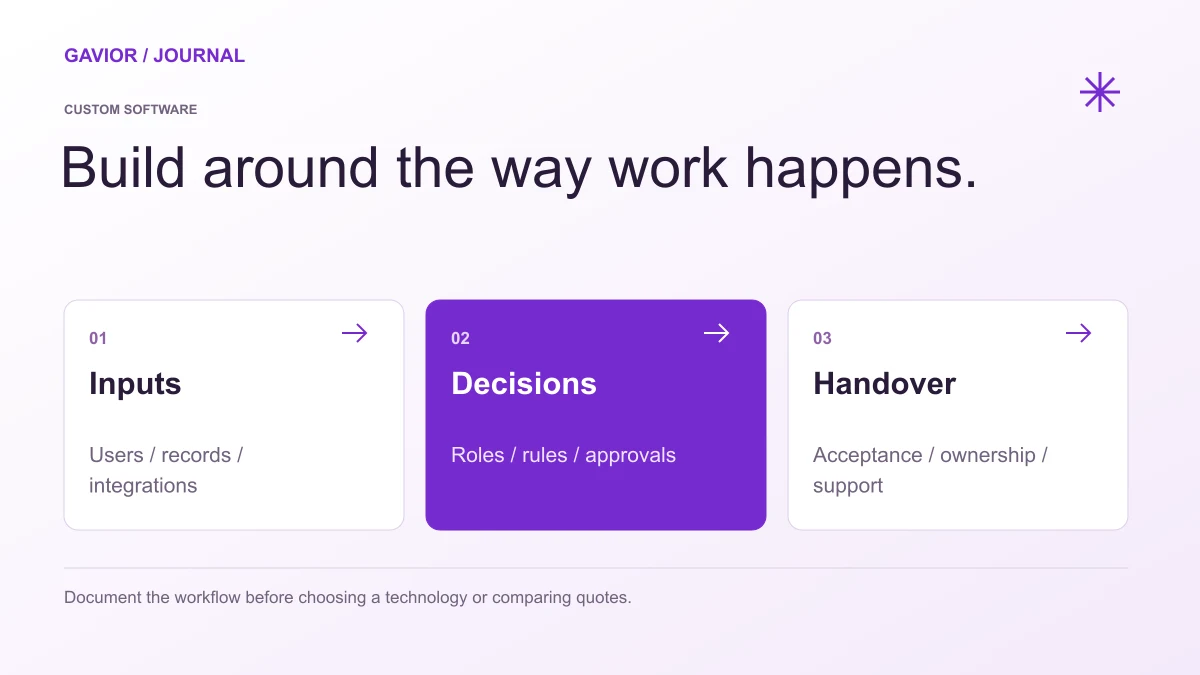
Transitioning away from legacy bottlenecks requires a disciplined, step-by-step strategy. Begin by auditing your operational workflows to identify high-volume manual tasks with clear inputs and outputs. Next, define strict human control boundaries and test your automation models in a sandbox environment before deploying them to production. Finally, pair your automated workflows with scalable cloud solutions on AWS or Azure to ensure high availability, global distribution, and continuous performance monitoring as your enterprise grows.
Ready to turn these ideas into results?
Move from insight to action with a solution aligned to your goals.