Calculate workflow automation ROI using task volume, handling time, recurring costs and realized value. Use an example to separate capacity from cash savings.
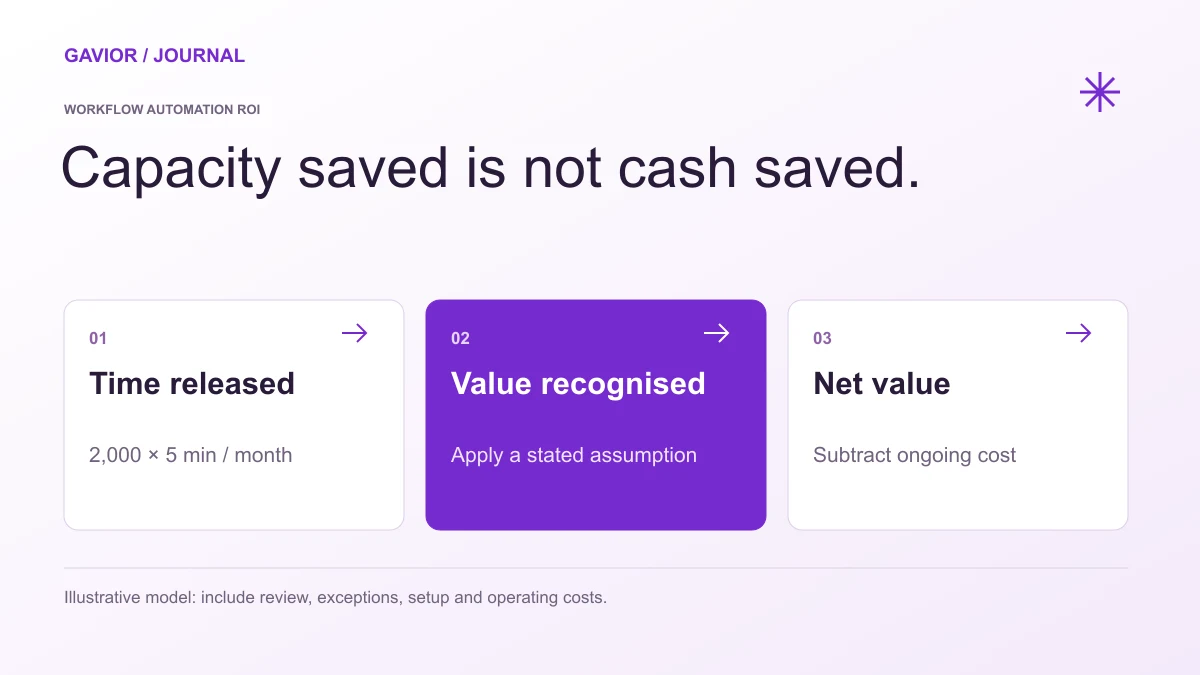
An illustrative calculation framework. Capacity saved is not automatically cash saved. View full-size image ↗
Workflow automation ROI compares the value realized from a workflow improvement with its setup and operating costs over a defined period. Measure task volume, handling time, exceptions and quality before estimating benefits. Separate staff capacity from cash savings, and include human review, provider usage, maintenance and change costs.
Make your move
Ready to turn a better idea into a better business?
Disclosure: Gavior provides automation development services. Every figure in the worked example below is an illustrative planning assumption, not a client result, market rate or promised saving. The guide was substantively reviewed on 28 October 2026; its original publication date is retained.
What should be measured before estimating ROI?
Measure the existing process as it operates, including exceptions, rework and supervision. Define one workflow and a comparison period before assigning a financial value to improvement. Otherwise, the business case can combine benefits and costs from different scopes.
Record task volume, active handling time, waiting time, error handling and the receiving team's capacity. Separate time spent doing work from elapsed turnaround time. An automation can reduce waiting without releasing the same amount of staff time.
Use the workflow selection guide to choose a manageable starting point. If a deterministic integration solves the problem, evaluate that option alongside an AI-assisted workflow instead of treating AI as a requirement.
How can the calculation be structured?
Use a common worksheet for the baseline, expected improvement, recognized value and full cost. State each assumption beside the calculation so the proposal can be challenged and updated after a pilot.
Input
Definition
Monthly task volume
Tasks that actually follow the scoped workflow
Handling minutes before and after
Average active work, including normal review and exceptions
Loaded hourly value
The business's approved basis for valuing time
Recognition factor
The share of released capacity that can realistically produce value
Setup cost
Assessment, build, migration, training and launch work included in the model
Recurring cost
Infrastructure, provider usage, maintenance and additional operation
Evaluation period
The same period used for both value and costs
Released hours per month = monthly task volume × (minutes before − minutes after) ÷ 60.
Recognized monthly capacity value = released hours × approved hourly value × recognition factor.
Period ROI = (recognized period value − total period cost) ÷ total period cost × 100.
The recognition factor is a planning assumption, not a standard benchmark. If time cannot be redeployed and no expense is removed, the cash-saving claim may be much smaller than the modeled capacity value, or absent.
What does a worked automation ROI example show?
A worked example should show both its arithmetic and the assumptions that make its result possible. The example below models a document-routing workflow with human review included in the after-automation handling time. It does not establish expected performance for another business.
Illustrative input
Assumption
Monthly tasks
2,000
Handling time before
8 minutes per task
Handling time after, including review and exceptions
3 minutes per task
Approved hourly capacity value
₹600
Recognized share of released capacity
50%
One-time setup
₹180,000
Monthly operating cost
₹35,000
Released capacity is 2,000 × 5 ÷ 60 = approximately 166.7 hours per month. At ₹600 per hour and a 50% recognition factor, the modeled monthly value is ₹50,000. After ₹35,000 operating cost, the modeled net monthly value is ₹15,000.
Over twelve months, recognized value is ₹600,000. Setup plus operation costs ₹180,000 + (12 × ₹35,000) = ₹600,000. First-year ROI in this example is therefore 0%, and the simple value-based payback period is twelve months. Cash payback is not established unless the capacity value becomes a verified financial benefit.
This is a useful result: a workflow can save substantial handling time without producing a strong first-year business case under conservative assumptions.
Which assumptions change the decision most?
Test the recognition of capacity, task volume, exception rate and operating costs instead of presenting one optimistic result. The model should make a weak scenario visible before the business commits to a larger implementation.
Recognition assumption, with other inputs unchanged
Monthly recognized value
First-year ROI
25% of released capacity
₹25,000
−50%
50% of released capacity
₹50,000
0%
100% of released capacity
₹100,000
100%
These are alternative assumptions, not observed outcomes. If task volume falls or review takes longer than expected, the business case changes again. Do not count the same benefit twice as both staff-cost reduction and additional output from that staff time.
What should an AI automation pilot prove?
A pilot should show whether the workflow completes correctly, how much human work remains and whether the resulting value can be used. Define representative inputs, difficult cases, approval boundaries and an owner for reviewing the evidence.
NIST's AI Risk Management Framework provides a voluntary reference for considering trustworthiness through AI design, use and evaluation. For a practical pilot, translate the relevant concerns into acceptance checks, human oversight and documented operating responsibilities. Referencing the framework is not a certification.
Record handling time after review, exceptions, incorrect actions, provider usage and support effort. Compare like-for-like tasks and explain any change in volume or difficulty. Expand the workflow only when the quality and value evidence support that decision.
Frequently asked questions
Is time saved automatically a cash saving?
No. Released time is capacity until the business demonstrates how it removes an expense or creates recognized value. Track those outcomes separately from the technical time saving.
Which automation costs are easy to miss?
Human review, exceptions, integration maintenance, provider usage, monitoring, training and changes to source systems can be overlooked. Assign owners and include the relevant costs within the same evaluation period.
Can an agency promise a universal ROI percentage?
A useful estimate needs the business's workflow data, actual costs and assumptions. A universal percentage without those inputs is not evidence of the value your implementation will produce.
What should we bring to an automation discussion?
Bring one workflow, representative task volumes, handling time, common exceptions and the systems involved. Explain who would review the output and how any released capacity would be used.