Website Development Company in India: Choose for Qualified Leads, Not Just a Launch
Gavior Editorial Team
Product and web delivery editorial team
Published: 2026-09-02Updated: 2026-09-02
How to choose a website development company in India when the site needs to explain a complex offer, earn trust and create qualified enquiries.
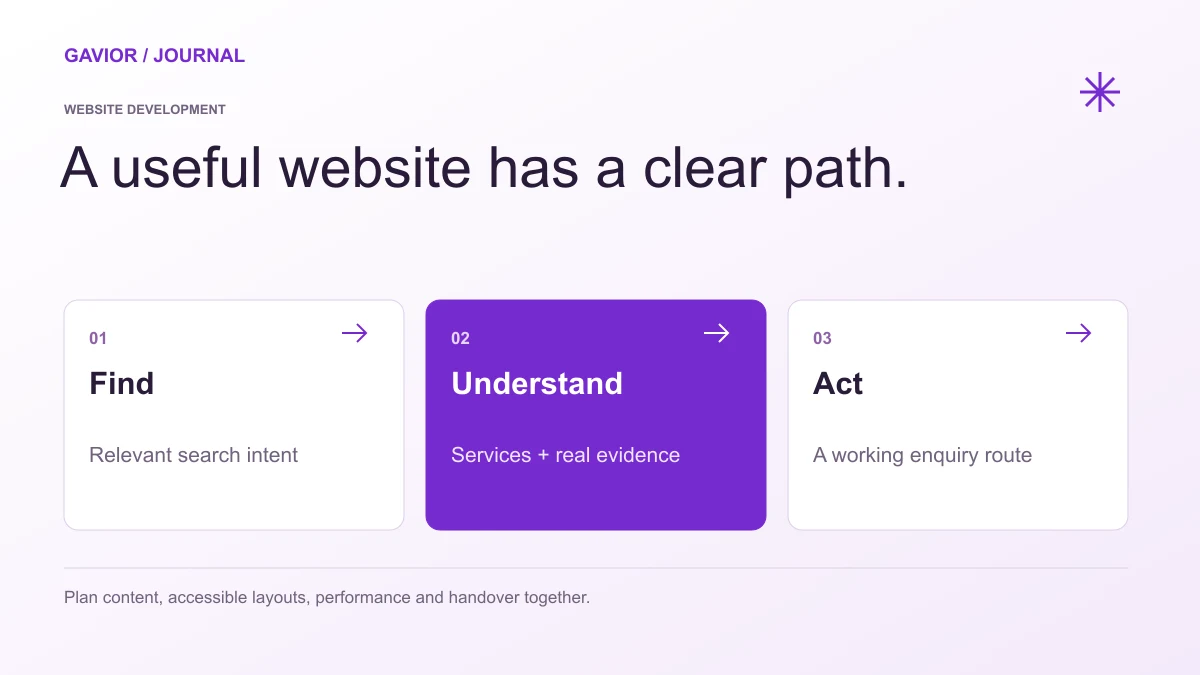
A website brief should connect content, user experience, delivery and ownership. View full-size image ↗
A website development company should be judged by more than whether it can launch an attractive homepage. If the site needs to generate qualified leads, it must help a specific buyer understand the offer, trust the business and move through a clear next step. That is a strategy, content, design, technology and measurement problem—not only a build problem.
Make your move
Ready to turn a better idea into a better business?
For a B2B company, a good website may need to explain an unfamiliar service, show how delivery works, answer implementation concerns and route different buyer types to the right conversation. For a local business, it may need to turn a high-intent search into a call, WhatsApp enquiry or appointment.
Define the conversion before design begins
The first project question should be: what should the right visitor do next?
Examples include:
Request a proposal with enough context to qualify the opportunity
Book a discovery call for a specific service
Start a product trial or request a demo
Enquire about availability, location or pricing
Download a useful implementation guide in exchange for consented contact details
Without this answer, teams often default to a visually polished site with no clear customer journey. The result may look modern and still fail to create a sales-ready enquiry.
Ask for a discovery process, not a template selection
Before a design system or technology stack is chosen, the delivery team should understand:
Primary audiences and decision-makers
Services, products and differentiators that can be substantiated
Sales questions and objections that the site must answer
Existing analytics, search demand and conversion data
Required integrations such as CRM, booking, payments, CMS or product APIs
Constraints around compliance, performance, content ownership and maintenance
This work does not need to be slow or over-engineered. It does need to happen. A template can be an efficient implementation choice once the information architecture and conversion path are known; it is not a substitute for them.
Evaluate the proposal with a practical checklist
Area
What to look for
Why it protects the project
Positioning
A clear view of the customer, offer and proof
Keeps pages from becoming generic service lists
Information architecture
A page map and navigation rationale
Gives buyers and search engines a coherent path
Content
Ownership, review process and page-level requirements
Prevents launch delays and empty pages
UX and visual system
Reusable components and responsive states
Keeps the experience consistent as the site grows
Engineering
Performance, accessibility, security and deployment approach
Reduces long-term operational risk
CMS and integrations
What editors can change and how data moves
Avoids a site the business cannot maintain
Search and analytics
Metadata, technical basics and conversion events
Makes future acquisition work measurable
Handover
Source-code, account and documentation ownership
Protects the business after launch
Build pages around the buyer's question
High-converting service pages usually answer practical questions in a useful order:
What is this service and who is it for?
Which problem does it solve?
What is included in the engagement?
What does the delivery process look like?
What constraints, timelines or dependencies should the buyer understand?
What proof, examples or technical details can the business responsibly show?
What should a qualified buyer do next?
This structure also makes the page easier to navigate and discover. Search systems need visible, descriptive text; a hero image, motion effect or vague slogan cannot carry the entire explanation.
Technology should follow the operating model
The most appropriate stack depends on the business:
A marketing-led site may need a CMS with editorial roles and structured content fields.
A SaaS website may need application integrations, feature documentation and performance-focused rendering.
An e-commerce operation may need inventory, payments, fulfilment and product-discovery flows.
A service business may need CRM, appointment, call or WhatsApp handoffs.
Ask the development company to explain the trade-offs in plain language: performance, editor experience, security, ongoing maintenance and cost. “Headless,” “AI-powered” or “custom” is not a meaningful answer without the operational reason.
Plan for search and conversion from day one
Search visibility starts with a crawlable, text-rich and internally connected site. But a page that ranks and does not convert simply creates a more expensive problem.
Define conversion events before launch, make forms and calls easy to use on mobile, and give every major page one next step that matches its intent. Then connect the site to the broader acquisition plan: SEO services, paid campaigns, useful articles and sales follow-up.
Red flags in a website proposal
A fixed design and build price without any questions about audience or conversion.
No page map, content plan or integration assumptions.
Vague claims about SEO without technical deliverables or measurement.
Agency-owned accounts that the business cannot access later.
A launch promise with no testing, handover or maintenance discussion.
An impressive portfolio with no explanation of what the team actually delivered.
Where Gavior fits
Gavior designs and builds custom websites, product experiences and connected digital systems for teams that need more than a brochure site. We can help shape the conversion path, content structure, visual system, engineering and launch measurement as one delivery process.