Ecommerce Website Launch Checklist for India: Scope, Test and Handover
Gavior Editorial Team
Commerce and engineering editorial team
Published: 2026-10-28Updated: 2026-11-09
Prepare an India-focused store launch with product, payment, delivery and migration checks, a reusable acceptance log and clear go-live responsibilities.
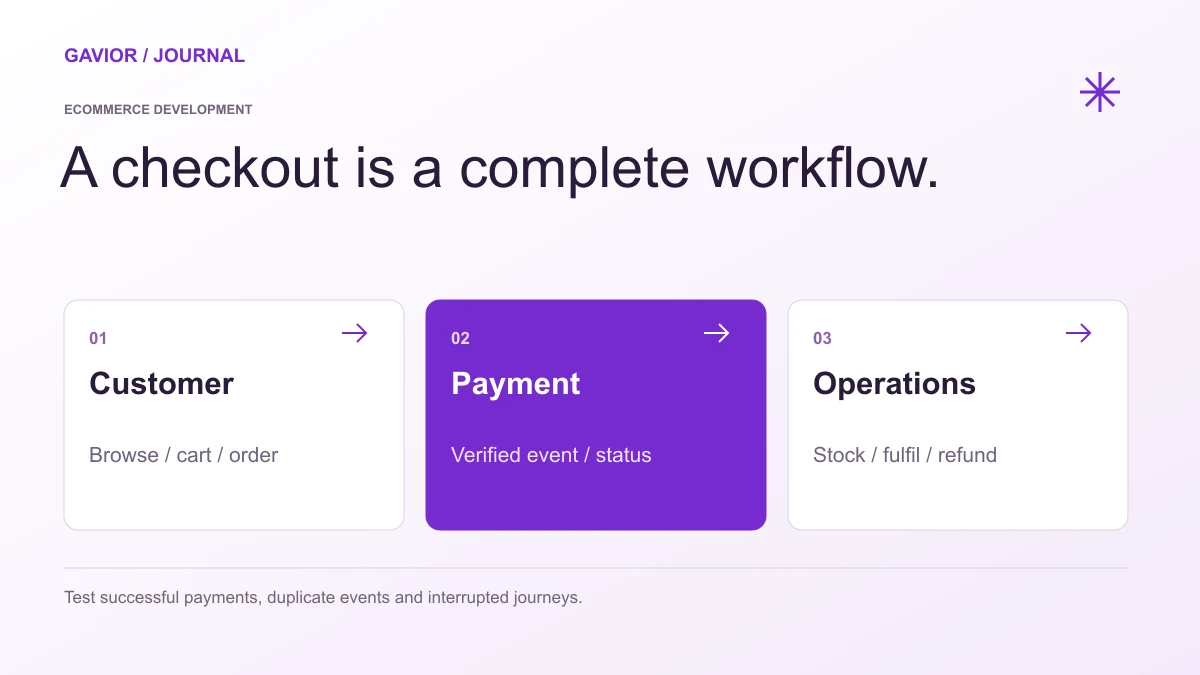
The order, payment and operational states should be reviewed as one workflow. View full-size image ↗
Ecommerce website development should cover the complete order journey: finding a product, choosing a valid variant, paying, receiving confirmation and handling fulfilment or a return. For an India-focused store, define the intended currency, payment methods, serviceable delivery locations and operational responsibilities before comparing development quotes.
Make your move
Ready to turn a better idea into a better business?
Disclosure: Gavior builds websites and commerce workflows. This checklist helps a store owner review scope and acceptance evidence. It is not a fixed-price package or a claim that every store needs custom software. Start with the ecommerce development company buyer guide if you are comparing suppliers.
What should you prepare before choosing a platform?
Prepare a representative product catalogue, the buying journey and the way orders are handled today. Include difficult products and exceptions, not only the simplest item. A platform decision is easier to evaluate when the operating requirements are visible.
For example, an illustrative homeware store might have one product sold in several sizes, limited stock and delivery to selected postcodes. The store owner should supply sample product data, variant rules, shipping constraints and the person responsible for refunds. This is a planning example, not an implemented client store.
Compare hosted and custom options against that workflow using the Shopify, headless and custom ecommerce decision guide. A custom build needs a specific business reason; visual preference alone does not explain its ongoing operating cost.
What should an ecommerce development scope include?
The scope should identify the customer-facing pages, order states, integrations and administrator tasks needed to operate the first release. Name the source of truth for product data, inventory, payment status and fulfilment so different systems do not make conflicting promises.
Work area
Questions for the brief
Acceptance evidence
Catalogue
Which variants, attributes and stock rules exist?
Representative products imported and editable
Discovery
How will customers find the correct item?
Working categories, search and useful empty states
Product page
Which details affect the purchase?
Price, availability, variant and delivery information agree
Checkout
Which address, currency and payment choices are supported?
Valid and invalid checkout journeys demonstrated
Orders
What do paid, failed, cancelled and refunded mean?
Documented state transitions and operator actions
Delivery
Where can the business fulfil an order?
Serviceability and shipping rules tested
Handover
Who operates each system after launch?
Account access, training and support responsibilities
Have the business's accounting and operations owners supply applicable invoice, tax, refund and policy requirements. The development team should implement the approved rules and identify any unresolved dependency before quoting it as complete.
How should payment and order confirmation be tested?
Test the relationship between the payment provider's verified status and the store's saved order. A customer seeing a success screen does not, by itself, demonstrate that order reconciliation, duplicate handling and fulfilment work correctly.
Razorpay's webhook validation guidance describes signature validation, duplicate events and events arriving out of order. If Razorpay is your chosen provider, ask the team to demonstrate those conditions in its test environment. Other providers need their own documented integration checks.
Test situation
What the business should observe
A payment completes normally
The corresponding order is saved and shows the agreed status
The browser closes after payment
The order can still be reconciled through the agreed backend process
A notification is delivered twice
It does not create a second order or a second fulfilment action
Payment fails or remains pending
The customer sees an accurate next step rather than an assumed paid order
The last available item is requested twice
The agreed stock and payment policy is applied consistently
A refund is processed
The order history and operational records show the agreed outcome
Decide who investigates mismatches and how they are alerted. Include reconciliation and support handling in the scope instead of treating them as unexplained work after launch.
Keep an acceptance log you can actually review
Use provider test mode and approved sample products/orders for pre-launch checks. Record what happened, not just that a developer ticked a box. This illustrative log can be copied into the project's own review document:
Check
Record before approval
Scenario and environment
Test case, release/build identifier, device and test-provider mode
Expected result
Saved order, stock change, customer message and permitted operator action
Actual evidence
Test order reference, redacted screenshot or reproducible steps
Decision
Pass, open issue or an explicitly accepted limitation
Responsibility
Person resolving the issue and person approving the launch decision
For the duplicate-payment-notification test, a useful result is one order and one fulfilment action after the event is repeated. Record both references so an attractive confirmation page does not hide a duplicated operation. Keep personal information and credentials out of shared test evidence.
What should be ready for search and mobile customers?
Product and category pages need clear content, stable URLs and usable navigation on small screens. A product should remain understandable without relying on a promotional image to communicate essential variant, price or availability information.
Google's Product structured data documentation explains supported product information in Search. Markup must represent the actual page and does not guarantee an enhanced appearance. Plan catalogue content and internal links before adding schema as a final task.
For a replacement store, inventory the existing category and product URLs and agree their destination map. Test a sample of valuable old URLs, unavailable products and redirects. The website redesign checklist covers the wider migration boundary.
Check a category containing more products than initially fit on the screen. Google's pagination guidance explains that crawlers normally follow links; they do not generally press a load-more button. Agree how later products remain reachable through crawlable URLs. Then compare the sitemap with the intended published catalogue rather than assuming that a successful homepage build includes every product.
Which costs and ownership decisions belong in the proposal?
Separate implementation fees from platform subscriptions, provider charges, paid extensions, hosting, maintenance and internal catalogue work. Agree who owns the domain, store, payment and analytics accounts and who can export the product and order data.
Ask the agency to price the actual catalogue and integration boundary, with exclusions beside the included work. Record what happens if an external API changes or a shipping integration is unavailable. A launch quote is incomplete when nobody owns the next operational step.
Who approves go-live and handles the first operating day?
Create a short release runbook before switching the public store. It should identify the release approver, deployment owner, payment and fulfilment contacts, and who can authorize reverting the change. Schedule the switch around the business's actual operating availability rather than an assumed agency handover time.
Release stage
Agreed check and owner
Before the switch
Final catalogue/price review, approved policies, account access and recoverable backup/export where applicable
During the switch
Public URL, checkout configuration, redirects and any agreed order/data cutover checks
Immediately after
Reachable categories/products, correct payment environment, order reconciliation and operator access
If a critical check fails
Defined stop/revert decision, preserved order references and a named incident contact
After launch
Owner and schedule for reconciliation, errors, stock exceptions, support and recurring charges
Agree the production verification method with the store owner and payment provider. Do not assume that customer emails, real charges or refunds can be triggered as casual tests. Keep test orders out of business performance reporting, and reconcile any approved production verification separately.
For choosing the delivery team rather than approving the release, use the agency evidence scorecard. The two decisions need different evidence: a supplier can present a convincing proposal while a specific release still has unresolved issues.
Frequently asked questions
Does every ecommerce store need a custom website?
No. Compare a hosted platform with custom development against the buying workflow and operating requirements. Choose custom work when there is a defined need that justifies its build and maintenance responsibilities.
What should an India-focused store specify about delivery?
Specify the locations you serve, address and postcode validation, shipping-rate rules, fulfilment ownership and unavailable-delivery behaviour. Have the operations team approve these rules rather than leaving them to assumptions in the interface.
How should we measure a successful launch?
Review completed, reconciled orders and operational exceptions alongside analytics. Product views and checkout starts help diagnose the journey, but a browser event alone is not proof that the business received and fulfilled an order.
What should we send to a developer for an estimate?
Send sample product data, variant and stock rules, intended payment and shipping providers, current URLs if migrating, and the order-handling process. Add your first-release priorities and known constraints.