Gavior Journal · Software Engineering · 5 min read
Software Development Rates by Country: 2026 Guide
Gavior Editorial Team
Software delivery editorial team
Published: 2026-09-24Updated: 2026-10-28
Compare published software development rates by country with their source limits. Use a quote worksheet to review hours, delivery scope and ownership cost.
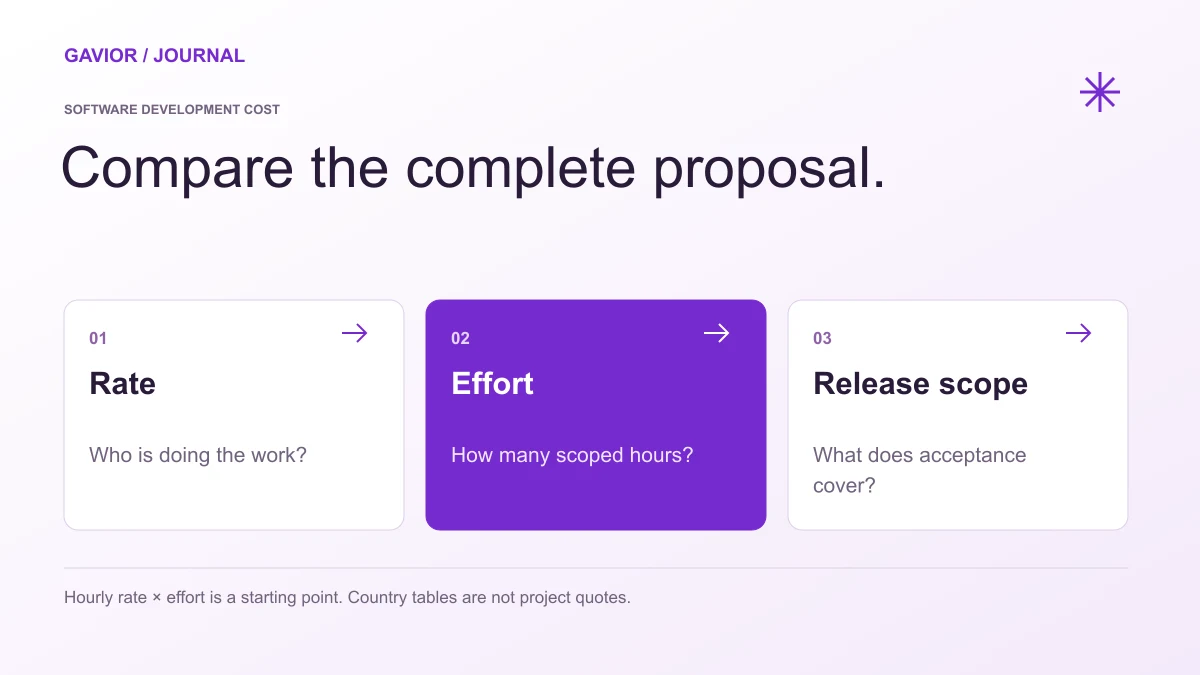
Country pricing observations do not substitute for a scoped project quotation. View full-size image ↗
Software development rates vary by supplier, team composition, scope and commercial model. Published country bands can frame a comparison, but they are not a quote for your project. Compare proposed hours, included deliverables, acceptance criteria and ongoing costs before treating a lower hourly rate as a lower total price.
Make your move
Ready to turn a better idea into a better business?
Disclosure: Gavior provides software development services. This guide was substantively reviewed on 28 October 2026, retaining its original URL and publication date. External directory observations, employee wage data and illustrative quote calculations are identified separately; none is a Gavior price or a guaranteed saving.
What published hourly rates can you use as a starting point?
Use published rates as a dated description of the source's own market coverage. They can help form questions for suppliers, but they do not establish the price, seniority or delivery quality of an individual team.
Clutch's 2026 software development pricing guide, updated 21 September 2026 and checked for this article on 28 October, publishes the following location bands. The dollar figures below are attributed to that guide, not to an independent Gavior survey.
Location
Clutch's published hourly band
United States
$50–$99
India
$25–$49
Canada
$100–$149
Australia
$100–$149
Poland
$50–$99
Philippines
$25–$49
United Kingdom
Listed as unknown
These directory bands are not national wage statistics, role-specific senior-engineer benchmarks or project quotes. The source does not provide a UK band in this table; this guide does not fill that gap with an invented estimate. Confirm the actual supplier's currency, staffing and written rate card.
Why are employee salaries different from agency rates?
Employee wage data measures a different relationship from a supplier's billable hourly price. An agency quote can include delivery management, non-billable work, overhead and commercial risk. Dividing an annual salary by working hours does not produce a reliable agency price.
For example, the US Bureau of Labor Statistics reports a May 2025 median annual wage of $135,980 for software developers. That is a dated employee-wage statistic, not a US software agency quote or a complete employer-cost estimate.
Compare like-for-like arrangements. Hiring an employee, retaining an individual contractor, buying a team's capacity and commissioning a fixed milestone each allocate different responsibilities to the buyer.
Which questions make country comparisons more useful?
Give suppliers the same release boundary and ask how their proposed team will deliver it. Geography can affect coordination, but it does not by itself specify who does the work, how it is reviewed or what is handed over.
Comparison area
Ask each supplier
Staffing
Which roles are included and who reviews the work?
Scope
Which complete customer workflows and integrations are covered?
Billing
What is billable, how are hours reviewed, and what approval limits apply?
Collaboration
What meeting overlap, decision process and review availability are needed?
Quality
Which demonstrations and acceptance checks support release approval?
Ownership
What source access, accounts, documentation and rights are included?
Continuing cost
Which hosting, licences, usage fees and support costs are separate?
If quotes use different currencies, record the conversion date and rate used for the comparison. Avoid treating a fixed conversion in an old article as the rate for a current contract. Clarify taxes and payment terms against the actual proposal with the appropriate business advisers.
How can a lower rate produce a higher project cost?
Hourly cost depends on the rate and the hours billed for the agreed scope. A comparison is incomplete when it looks at only one of those inputs or ignores work excluded from the headline quote.
Consider two illustrative quotes in the same currency for an agreed release:
Illustrative quote
Rate
Estimated hours
Development subtotal
Team A
$30/hour
600
$18,000
Team B
$45/hour
350
$15,750
Team A has the lower hourly rate but the higher estimated subtotal. This arithmetic does not prove Team B is more productive or that either estimate is accurate. Compare scope, assumptions, roles, acceptance evidence and overrun handling before drawing that conclusion. Neither example is a market benchmark or a Gavior quote.
Add excluded work and ongoing operation over the same comparison period. The SaaS MVP estimate guide provides a worksheet for reviewing those boundaries.
Should a project use hourly billing or priced milestones?
Choose a commercial model that fits how well the work is understood and how changes will be approved. Hourly work needs a clear capacity, review and spend-control arrangement. Priced milestones need explicit deliverables, assumptions, acceptance and a change process.
Neither model guarantees a good outcome. A vague fixed-price milestone can conceal exclusions, while an undefined hourly engagement can leave the buyer unable to assess progress. Ask what working result you will review before the next commitment.
For Gavior's SaaS engagements, the scope sprint fee is agreed before kickoff and build milestones are priced after scoping. Use the current engagement page and an actual written proposal for commercial terms. This guide does not publish a universal Gavior hourly rate or a delivery duration.
Frequently asked questions
Are country rate tables quotes for my project?
No. A published band describes the source's reported market coverage. Your quote depends on the supplier, roles, workload, delivery boundary and terms being agreed.
Can I infer a national average from one directory?
Do not treat a directory's listed bands as a representative national estimate without evidence for that interpretation. Retain the source, date and scope when using the figures in a comparison.
What should I compare when a country has no reported rate?
Obtain current proposals or rate cards from suitable suppliers using the same brief. Mark missing information as missing rather than extrapolating a nearby country's band.
What should I send Gavior for an estimate?
Send the user journey, existing code or designs, required integrations and first-release priorities. Include known budget and timing constraints so the team can discuss an appropriate scoping step.