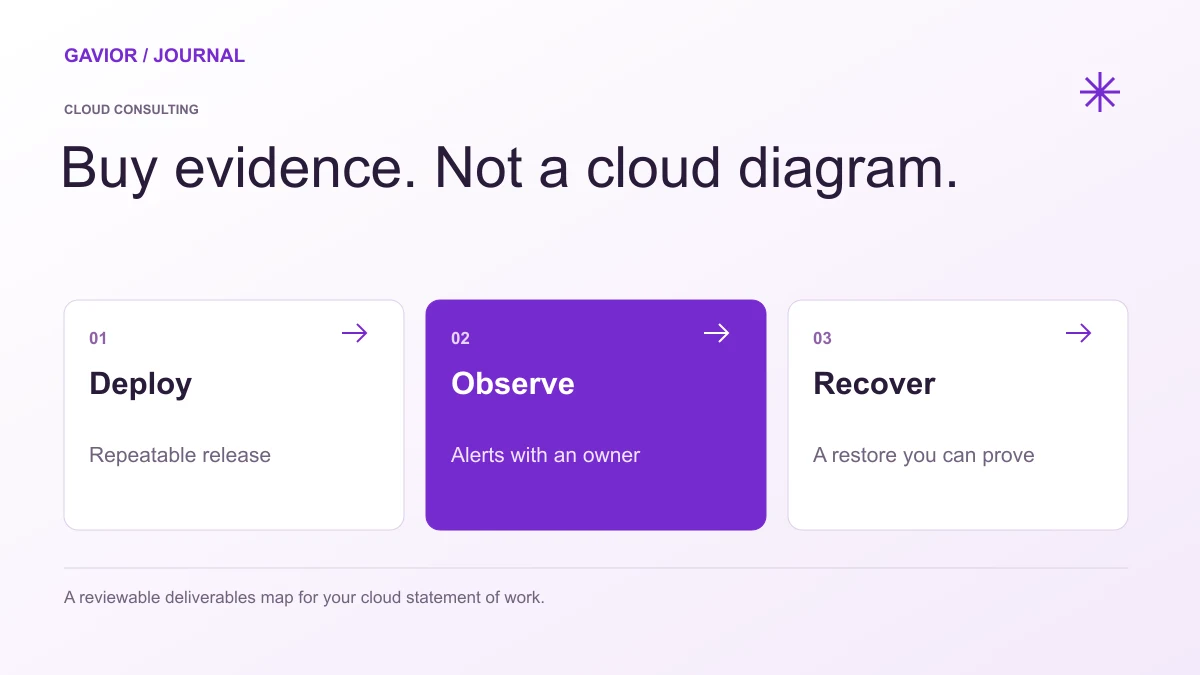
Compare cloud consulting in India using written deliverables, acceptance checks, operating costs and ownership. Use a scope checklist for a reviewable proposal.
A cloud consulting proposal should define the workload, intended outcome, architecture decisions, implementation boundary and operating handover. Compare consultants using the evidence they will deliver and the responsibilities they accept, including recovery checks and ongoing costs, rather than comparing a list of cloud services or provider logos.
Make your move
Ready to turn a better idea into a better business?
Disclosure: Gavior provides cloud and engineering services. This is a buyer's scope checklist, not an independent ranking or a claim of a provider certification. The cloud consulting company guide covers the broader supplier comparison.
What outcome should the statement of work describe?
The statement of work should name one operational outcome and the constraints that shape it. Launching a new API, moving an existing database and improving recovery are separate projects. Their scope cannot be compared through an identical "cloud setup" label.
For an illustrative SaaS launch, the outcome might be a production application with separate development access, a defined deployment path and a demonstrated restore procedure. The brief should identify the application, existing data, integration dependencies, review owner and acceptable service interruption. This example does not specify a universal architecture or a delivery promise.
Use the SaaS MVP scope checklist to define the application boundary before asking infrastructure providers to estimate it.
Which cloud consulting deliverables should you request?
Request deliverables that explain decisions, demonstrate implementation and leave a named team able to operate the result. A diagram is useful when it records assumptions and ownership; it is not a substitute for deployment, recovery and access evidence.
Deliverable
What it should explain
How the buyer reviews it
Workload and dependency inventory
Applications, data, external services and owners
Confirm it includes the actual production journey
Architecture decision record
Chosen approach, constraints and alternatives
Check decisions against the workload and budget
Identity and access plan
Named roles, service identities and access boundaries
Demonstrate required access without shared credentials
Deployment procedure
Environments, release steps and failure handling
Review a representative deployment and rollback
Recovery plan
Backups, restore steps and approved recovery objectives
Observe a restore exercise in the agreed environment
Cost model
Expected usage, recurring components and exclusions
Review assumptions and ownership of billing alerts
Operating handover
Runbooks, alert recipients, accounts and support boundaries
Have the receiving operator follow the documentation
AWS's Well-Architected pillars provide a reference across operational excellence, security, reliability, performance efficiency, cost optimization and sustainability. A project scope should translate relevant concerns into concrete decisions rather than treating a framework checklist as proof that the workload has passed a review.
How should acceptance criteria be written?
Acceptance criteria should describe a repeatable action, its expected result and the evidence the customer receives. Terms such as "secure", "scalable" or "production ready" need a defined workload and review boundary before they become meaningful commitments.
For the illustrative SaaS launch, an acceptance record could include these checks:
An authorized operator deploys the approved release using the documented process.
A failed release can be returned to the agreed previous state.
A representative backup is restored and the application can retrieve the expected records.
An agreed fault condition reaches the named alert recipient.
Production access uses the approved roles and can be removed when the engagement ends.
The customer can locate provider accounts, billing information and operating documentation.
Define the environment, sample data and exclusions for each check. A restore demonstration on a small sample does not establish every possible recovery time for a larger production dataset.
Who owns security and operations after delivery?
The proposal should identify what the cloud provider manages, what the consultant implements and what the customer operates. These responsibilities depend on the services and engagement selected. A hosted platform does not remove every application, identity or data-management responsibility.
AWS's shared responsibility explanation distinguishes provider infrastructure responsibilities from customer responsibilities, which vary by service. For your project, turn that distinction into an owner list for access, configuration, application updates, backups, alerts and incident response.
Keep provider accounts under the business's control. Specify which consultant access ends at handover, who receives operational alerts and which support hours or response arrangements are actually included. Do not treat implementation access as an indefinite support agreement.
What should the cost comparison include?
Separate consulting fees, migration work and ongoing infrastructure charges. Ask for the usage assumptions behind the estimate and a review of what changes when traffic, storage, retention or external-service usage grows.
Cost boundary
Questions to resolve
One-time work
Which assessment, implementation, migration and training tasks are included?
Provider usage
What workload and retention assumptions drive recurring charges?
External services
Which monitoring, messaging or other subscriptions are separate?
Customer operation
Who reviews bills, maintains access and responds to alerts?
Change requests
How are additional environments, data or reliability requirements priced?
If migration is involved, add a separate cutover and rollback plan. Do not assume a steady-state hosting estimate also prices the migration and its verification.
Frequently asked questions
Do we need to choose AWS, Azure or Google Cloud first?
Start with the workload, existing skills, integrations and operating constraints. A consultant can compare suitable options within a defined scope. A provider preference alone is not an architecture or a cost estimate.
Does an architecture diagram complete a cloud engagement?
Only if the agreed engagement is an architecture assessment. An implementation engagement also needs its defined deployment, access, recovery, documentation and handover evidence.
Can a consultant guarantee zero downtime for every migration?
Do not accept that as an undefined promise. Agree the actual migration method, dependencies, rehearsal, acceptable interruption and rollback conditions for the workload being moved.
What should we send Gavior for a cloud proposal?
Describe the application, current hosting, data, intended outcome and operating team. Identify any migration, customer security requirements and known budget constraints so the assessment can be scoped.