
Gavior Journal · Cloud Engineering · 5 min read
AWS Backup Restore Testing: A Business Acceptance Checklist
Cloud and engineering editorial team
Commission a recovery drill with clear data-loss limits, realistic application checks, named owners and an evidence log before relying on a backup.
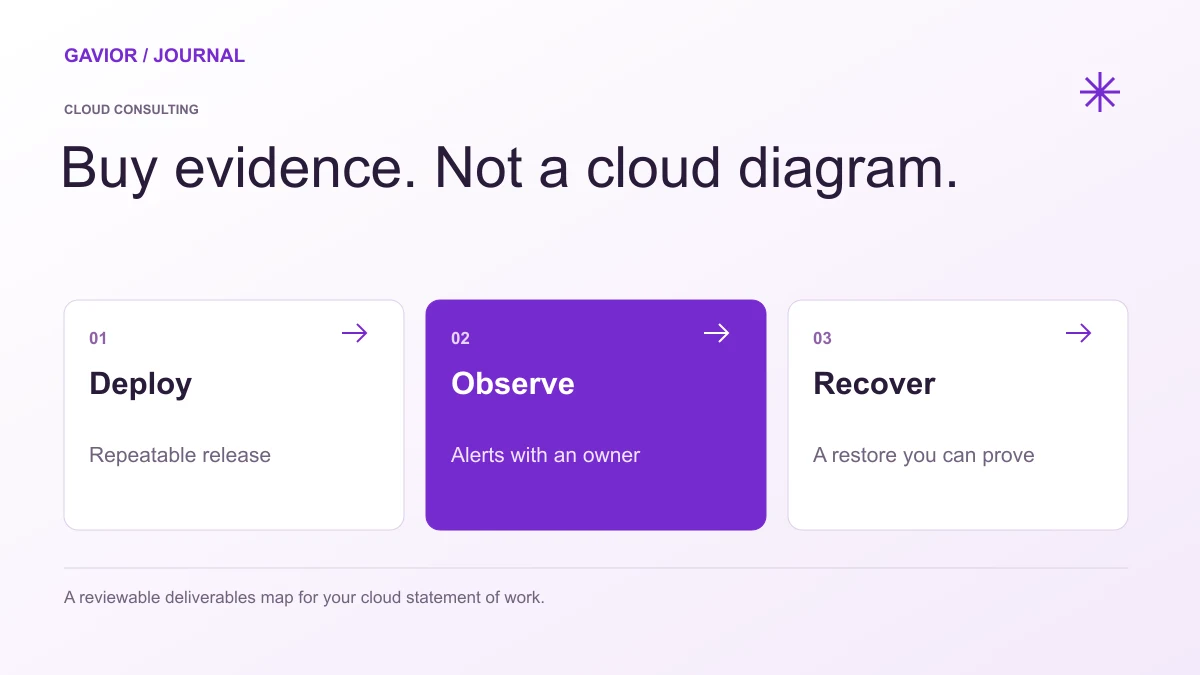
A successful backup job tells you that a copy was created. A recovery test asks a different business question: can the team use that copy to bring an agreed workflow back within an acceptable time and data-loss window? Before buying more storage or commissioning a cloud assessment, agree how that question will be answered.
This guide helps a business specify and review a recovery exercise. It is not a procedure to run against a live account. The appropriate method depends on the application, information sensitivity, dependencies and authorized engineering team. Gavior provides cloud services; the worksheet below is an illustrative planning tool, not a reported client result.
Start with the workflow you need back
Name a business activity rather than only a server. For example, an illustrative wholesale operation might need staff to retrieve customer orders, see stock allocations and produce a dispatch list. Restoring its database alone would not prove that staff can sign in or that the dispatch export works.
Ask which databases, files, configuration, identity services and integrations that activity needs. Record where their recovery material is held and who can access it. A credential reference belongs in the workbook; the password itself does not. Include an alternate authorized operator so the exercise does not rely on one person's laptop.
For a planned platform move, keep recovery evidence connected to the cloud migration cutover and rollback plan. A periodic recovery drill and a production migration are related but separate engagements.
Turn RTO and RPO into approval decisions
Recovery time objective, or RTO, describes the target time to resume the agreed service. Recovery point objective, or RPO, describes the acceptable data-loss interval. The business owner should approve those targets after discussing the consequences of interruption.
AWS's periodic recovery guidance recommends recovering and validating data against these objectives. That means checking usability and integrity, not assuming a completed backup is sufficient. Compare measured recovery evidence with the targets; do not transfer a target from another company or treat a successful infrastructure job as proof of the whole application.
Use a recovery acceptance worksheet
| Decision | What to agree before the exercise | Evidence to retain |
|---|---|---|
| Recovery boundary | One named customer or staff workflow and its dependencies | Included systems and exclusions |
| Recovery point | Which copy or point in time is selected | Backup identifier and data timestamp |
| Time measurement | Start, completion and business validation conditions | Recorded checkpoint times |
| Data checks | Representative records, files and relationships | Expected versus observed results |
| Application checks | Approved read and write scenarios in the isolated test | Test results and unresolved defects |
| External effects | Email, payments, webhooks and scheduled jobs that must not reach real customers | Isolation and test-provider configuration |
| Cleanup | Resource owner, deadline and confirmation method | Cleanup status and remaining exceptions |
Keep this as an evidence log, not a row of unchecked promises. Assign a person to every open item and distinguish a failed check from a check that was never performed.
Plan a safe rehearsal environment
Agree authorization, access and the test location before restoring anything. The exercise should account for data protection and prevent restored workers or integrations from contacting real customers. Use approved test endpoints or disable outgoing effects according to the runbook. Do not copy production information into an informal shared environment just to make the demonstration easier.
Also decide whether the operator follows existing documentation or receives help from the original developer. These measure different things. A guided demonstration may show technical feasibility; a documented handover exercise tests whether the next authorized operator can repeat it.
Understand what AWS Backup testing covers
AWS Backup restore testing can schedule restore exercises for supported resources and record restore-job duration. Application validation needs its own defined checks. Review supported resources, permissions, validation windows and cleanup behavior for the chosen configuration.
Allow for testing and restored-resource costs rather than describing the exercise as free. The written scope should identify who monitors cleanup and investigates resources that remain. Provider capabilities do not by themselves establish that your business workflow or recovery objectives have been met.
Read the result as a business owner
In the wholesale example, the team might restore the selected data, sign in using an approved test account, locate an agreed sample order, compare its lines and stock allocations, then produce a dispatch preview without sending it externally. Those checks define a demonstration; the article does not claim a particular elapsed time or successful result.
If infrastructure restoration succeeds but sign-in fails, record partial recovery. If the workflow works but the selected data is too old, the data-loss objective remains unmet. Ask for a corrective action and another agreed test instead of changing the target after seeing the result.
What should the engagement deliver?
Request an inventory, approved recovery objectives, an executable runbook, an evidence log, unresolved actions and named owners for repetition. Separate a one-time assessment from implementation, scheduled testing, incident response and ongoing support. Frequency should follow workload risk and meaningful changes; avoid assuming a universal schedule suits every system.
Use the cloud consulting deliverables checklist to compare the proposed engagement. To discuss a specific workload, send a cloud project brief with the workflow, existing provider, known backup arrangement and recovery concern. Share a description first; account credentials and customer records are not needed in an initial enquiry.
Gavior Editorial Team
Cloud and engineering editorial team at Gavior
The Gavior Editorial Team publishes practical guidance on cloud operations, software delivery and business requirements.
Explore Related Gavior Capabilities
Cloud solutions
Practical cloud architecture, migration and operational foundations.
DevOps services
Safer deployments, observable systems and repeatable delivery workflows.
Manufacturing Software Solutions
Tailored engineering, automation, and enterprise systems for manufacturing leaders.
Retail Software Solutions
Tailored engineering, automation, and enterprise systems for retail leaders.
Further Reading
Cloud Migration Cutover Plan: What a Business Should Approve Before Moving
Plan a production cloud migration with a dependency inventory, tested recovery, data cutover rules, rollback decisions and evidence that customer workflows still work.
Cloud Consulting in India: Deliverables Checklist
Compare cloud consulting in India using written deliverables, acceptance checks, operating costs and ownership. Use a scope checklist for a reviewable proposal.