B2B Company Website Structure: Pages That Help Buyers Evaluate You
Gavior Editorial Team
Product and web delivery editorial team
Published: 2026-10-07Updated: 2026-10-07
Plan a B2B website page map for multiple stakeholders, long buying cycles, technical questions and qualified demo requests.
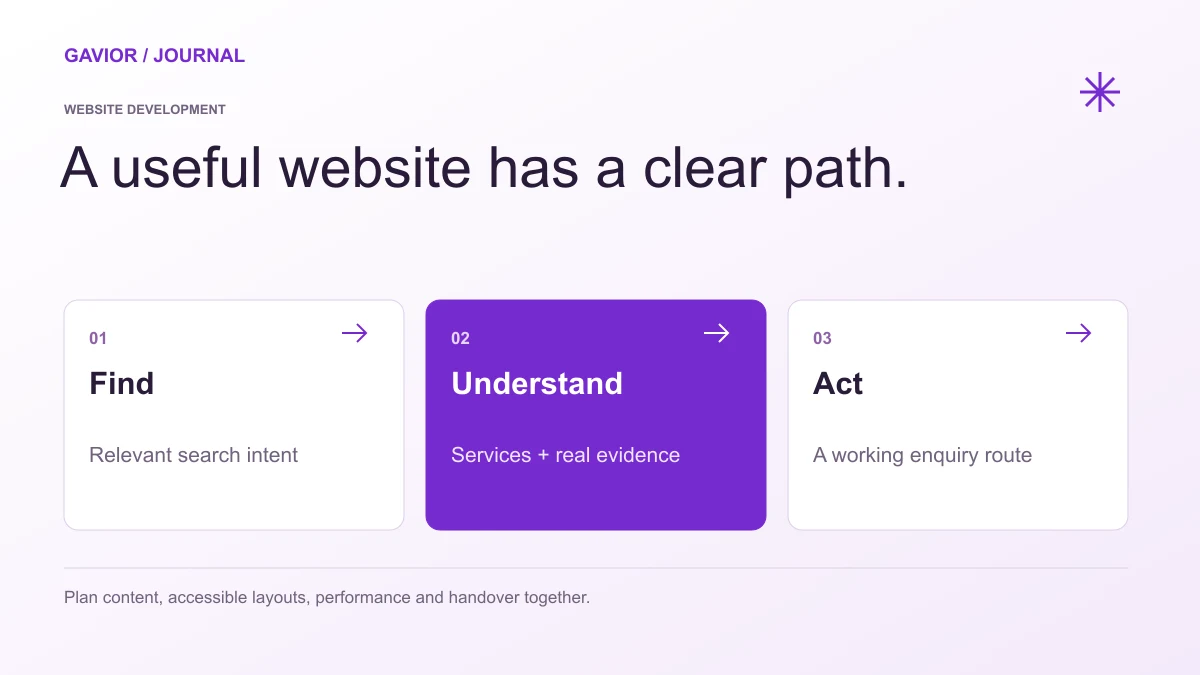
A website brief should connect content, user experience, delivery and ownership. View full-size image ↗
A B2B website often serves several readers at once. A business sponsor wants an outcome, a technical reviewer wants implementation detail, procurement wants commercial clarity, and an end user wants to know how work changes. A homepage that tries to answer every question in one screen usually answers none of them well.
Make your move
Ready to turn a better idea into a better business?
The page structure should let each reader find a credible path without forcing them through a sales form too early. In practice, that means clear offer pages, an explanation of delivery, inspectable evidence and a contact route suited to the buyer's stage. Use the framework below before writing navigation labels or selecting a website template.
Which pages does a B2B company website need?
Start with pages that answer the sponsor's business question, the evaluator's technical question and the buyer's trust question. Add other pages only when they serve a distinct decision.
Interview sales and delivery teams about the questions that recur in real conversations. Group them by buying stage and role. Avoid inventing personas with no evidence; call recordings, proposals, support questions and search data are better inputs.
Reader
Question they need answered
Likely page or section
Business sponsor
What problem can you solve for us?
Solution or service overview
Technical evaluator
Will this fit our systems and constraints?
Technical approach, integrations or documentation
Procurement
What is included and how do we engage?
Process, scope and contact route
End user
How will this affect daily work?
Workflow explanation or product tour
Executive reviewer
Why should we trust this team?
About, team and approved evidence
The same visitor may play several roles. The goal is a clear path between pages, not a maze of audience labels.
Start with a compact core page map
Most B2B teams need a clear homepage, service or product pages, an explanation of approach, company information, contact and evidence. Add industry pages only when you can explain a real industry-specific problem, constraint or implementation. Repeating a generic service paragraph for ten industries creates weak pages and an avoidable maintenance burden.
For each important offer, one dedicated page should state who it is for, what is included, how delivery works, prerequisites, common objections and a suitable next action. If the business sells a complex product, deeper pages can explain integrations, security practices and migration without crowding the overview.
Design the navigation around choices
Navigation labels should describe destinations plainly. “Solutions” is useful only when visitors can understand what choices sit underneath it. A large menu may be justified by a large content library; otherwise, it can make a small site harder to use. Put the important route in the primary navigation and retain a consistent contact path across pages.
Breadcrumbs and related links help a reader move from an overview to detail and back. A buyer arriving directly from search should understand where the page sits in your offer. Do not assume everyone enters through the homepage.
Show evidence at the right depth
Use case studies when the client has approved the facts you publish. Explain the initial problem, your work, constraints and observed result; avoid a number with no context. If confidentiality prevents named examples, describe a clearly labelled anonymized project with only information you are allowed to share. Product screenshots, process diagrams, team bios and documentation can also provide useful evidence.
Tell buyers what happens after they submit a request. A demo form might ask for role, use case and preferred contact details. A technical buyer may prefer documentation first. Giving both routes can improve the quality of the conversation without adding unnecessary friction.
How do you validate the page map before design?
For every page in the proposed site, assign an owner, a primary question, required assets and a next action. Mark whether content already exists, needs editing or needs research. This prevents a build from reaching development while core claims and proof are still undecided.
Review the map with sales, delivery and a customer-facing colleague. Ask each person to complete a task, such as finding the integration approach or submitting a project brief. If they cannot find it, revise the structure before visual design is approved.