Lead Generation Website for Service Businesses: What to Include
Gavior Editorial Team
Product and web delivery editorial team
Published: 2026-10-07Updated: 2026-10-07
Plan a service business website around qualified enquiries, clear service pages, trust evidence and a measurable follow-up process.
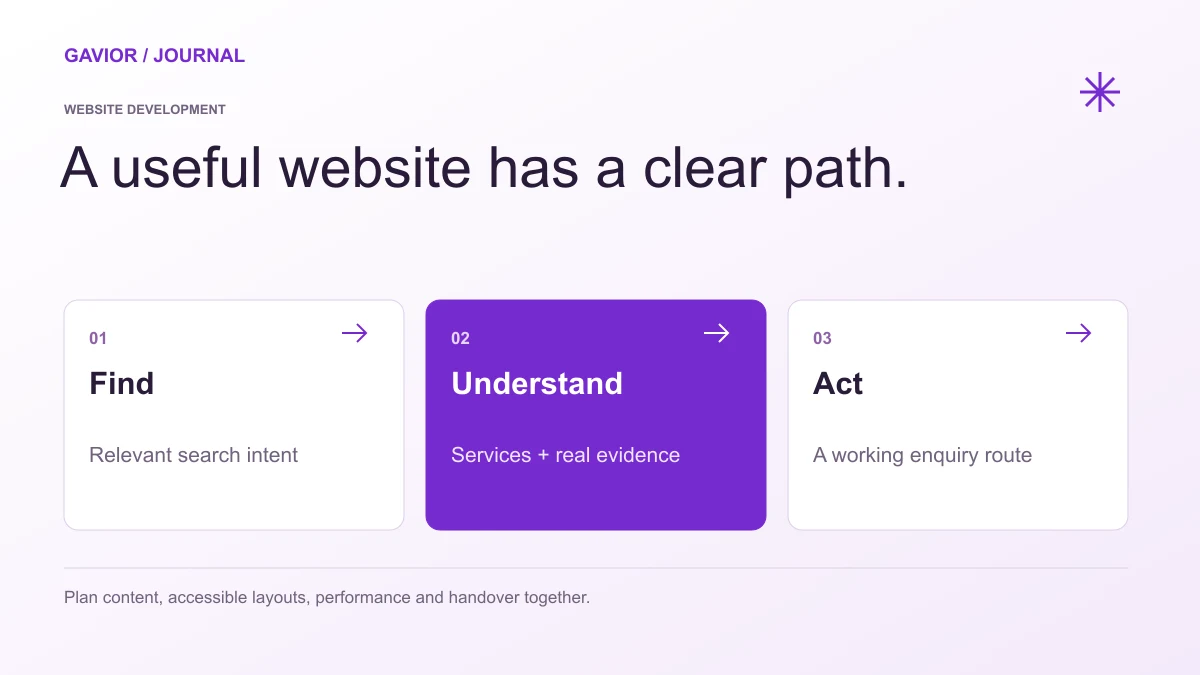
A website brief should connect content, user experience, delivery and ownership. View full-size image ↗
A service business website has one difficult job: help the right prospect understand the offer well enough to start a useful conversation. Counting every form submission as a success can hide the real problem. A visitor asking for a service you do not provide creates work, while a qualified visitor who cannot find the right next step leaves unnoticed.
Make your move
Ready to turn a better idea into a better business?
Before you commission a lead generation website, write a short brief about the customers you want, the questions they ask and the information your team needs to respond. A useful site then pairs dedicated service pages with relevant proof, a clear enquiry path and a reliable follow-up process. That brief is more valuable than a request for a particular visual effect.
What makes a service website generate qualified leads?
It answers a specific customer's question and offers an appropriate next step. Define a qualified lead first so the page and form can support that result.
For each service, describe an enquiry your team would welcome. An architecture practice might need location, project type and approximate stage. A B2B software consultancy may need the business problem, existing system and decision timeline. Ask for only what helps the first response; a long form can block a good prospect.
Use this decision table to specify the conversion path:
Visitor intent
Page should answer
Appropriate next step
Learning about the service
What is included, who it suits and how work begins
Read a detailed service page
Comparing providers
Relevant process, examples and team responsibilities
Request a scoped conversation
Ready to buy
Availability, response route and required project details
Book a call or send a brief
Needs urgent help
Whether urgent support is available
Call the published contact number
The table makes the call to action a consequence of the visitor's intent. A generic “Submit” button everywhere does not do that work.
Give each core service a useful page
A single page listing every offering rarely answers specific buyer questions. Give important services their own pages with a descriptive heading, scope, exclusions, process, relevant examples and a clear enquiry route. Explain terms in the customer's language. If you offer website redesign, state whether content migration, redirects and analytics setup are part of that work.
The homepage should orient visitors quickly and send them to the most relevant service, industry or proof page. It does not need to repeat every service page in full. A clear page map also gives your developer a plan for navigation and internal links.
Make trust inspectable
Trust comes from specific, verifiable information: who does the work, how discovery and delivery happen, what the customer must provide, and examples you have permission to show. Do not invent client logos, testimonials or performance figures to fill a design. If a portfolio is limited, explain your method and show a realistic project scenario clearly labelled as an illustration.
Put contact details, business identity and a privacy explanation where a prospect expects them. For a location-based service, state actual service areas. For a worldwide service, explain time zones and communication expectations instead of claiming a local presence everywhere.
Connect the website to response operations
Decide where form entries go, who owns the inbox, how duplicate enquiries are handled and what happens outside business hours. A CRM integration is useful when it removes manual copying or preserves lead context; it is not a substitute for an agreed response process.
Track meaningful events such as form success, appointment completion and qualified enquiries. A button click alone does not prove the request arrived. Test the journey on a phone, including field validation, confirmation and the notification received by your team.
What should go in the project brief?
Primary services and customers you want to attract
A lead definition for each important service
Existing copy, photography and approved proof you can supply
Page map, enquiry routes and booking requirements
CRM, email, WhatsApp or phone handoff requirements
Who can edit content after launch
Events you need to measure and who will review them
Required privacy, accessibility and maintenance considerations
Ask the agency to explain which items are included in its proposal and which require a separate decision. Compare proposals on this same brief so the cheapest number does not conceal missing content or integration work.