
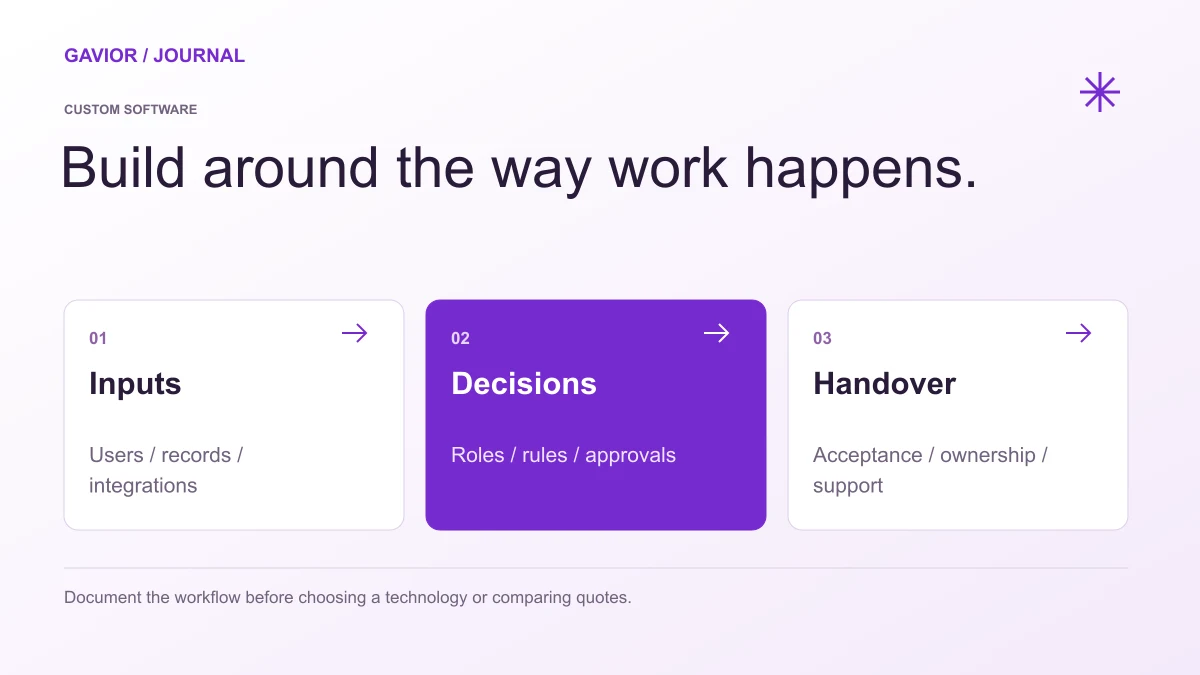
An enterprise web applications development company designs, builds, and maintains custom software systems engineered to handle complex business logic, massive transaction volumes, and rigorous compliance mandates. These specialized engineering firms exist for organizations that have outgrown off-the-shelf software and need purpose-built platforms that reflect their operational realities. At Gavior, we build enterprise systems that cut through operational friction, replacing fragile workarounds with dependable, scalable digital infrastructure.
- Custom enterprise software solutions align directly with organizational workflows instead of forcing teams into rigid third-party frameworks.
- Architectural decisions between modular monoliths and microservices determine long-term total cost of ownership (TCO) and system maintainability.
- Legacy system modernization succeeds by introducing iterative, functional increments rather than risky big-bang code rewrites.
- Security protocols like SOC 2, GDPR, and HIPAA must be built directly into daily development cycles and CI/CD deployment pipelines.
Defining Your Digital Engineering Requirements
Hiring an enterprise web applications development company begins with rigorous scope definition. Standard platforms frequently crack under unique organizational rules, high concurrent user loads, and non-standard data models. Bespoke software engineering eliminates this friction by shaping code around your operational reality rather than forcing your operations into someone else's product template.
Large-scale projects require a disciplined Software Development Life Cycle (SDLC). Before writing code, engineers must map user roles, isolate tenant boundaries, establish data validation rules, and calculate network traffic thresholds. At Gavior, our approach to enterprise applications follows four distinct stages: understand the real business decision, design the smallest meaningful system, build and refine collaboratively with your team, and measure what actually moves the company forward. Whether your project centers on custom Web Development or complex Web App Development, establishing clear functional gates prevents expensive revisions down the road.
Discovery must be practical. Treating an enterprise build as a static deliverable invites scope creep, missed deadlines, and ballooning budgets. Senior engineering teams audit existing internal workflows, flag redundant steps, and define exact boundary conditions. Grounding initial builds in clear user milestones keeps code clean and prevents teams from building complex tools that employees actively avoid using.
Architectural Strategy: Microservices Versus Modular Monoliths
The core architectural debate in enterprise engineering often centers on Microservices architecture versus modular monoliths. Microservices split business capabilities into decoupled services communicating over HTTP or gRPC. This allows distinct squads to deploy independently. However, microservices introduce substantial distributed systems overhead, including eventual consistency issues, complex network latency management, and steep cloud infrastructure bills.
For many scaling organizations, a well-structured modular monolith provides superior performance, simpler debugging, and drastically reduced operational complexity. Domains remain strictly partitioned inside a single codebase, allowing teams to split compute-heavy services into isolated workers only when transaction density demands it. Sound expert analysis evaluates actual user concurrency, read-to-write ratios, and organizational structure before committing to distributed infrastructure.
Regardless of the high-level pattern selected, your Enterprise technology stack (.NET, Java, React, Node.js, Python) must match your team's maintenance capabilities. Python excels in asynchronous data pipelines and analytical processing; Java and .NET provide proven type safety and memory management for transactional financial systems; and Node.js coupled with React provides unified runtime efficiency for dynamic user interfaces.
API Integration, Middleware, and Legacy System Modernization
Enterprise applications do not operate in a vacuum. They must exchange high-integrity data with existing back-office systems, payment gateways, and data warehouses. This requires robust API integration and middleware capable of transforming schemas, managing rate limits, and orchestrating asynchronous communication.
Legacy system modernization rarely succeeds as an abrupt rip-and-replace project. Complete rewrites carry high failure rates because undocumented business logic gets lost in transition. The safer route uses the Strangler Fig pattern. Here, an engineering partner deploys a modern web application alongside the legacy monolith, progressively routing traffic to modern micro-endpoints while keeping daily operations running smoothly.
Seamless ERP and CRM integrations are critical. Whether synchronizing inventory with SAP, managing accounts inside Salesforce, or processing global payouts through custom gateways, your middleware layer must handle network timeouts, queue retries, and data dead-lettering. Resilient messaging queues such as RabbitMQ or Apache Kafka decouple critical data pathways, ensuring external API latency never freezes your main application thread.
Engineering for Scalability, Security, and Cloud Resilience
Scalability and high availability require intentional infrastructure design. A Cloud-native architecture deployed across platforms like AWS or Azure uses auto-scaling application clusters, distributed load balancers, and multi-zone database read replicas to absorb traffic surges without manual intervention. Multi-region failover and automated snapshotting keep downtime within strict operational boundaries.
Security is not a checkbox added right before production launch. Enterprise data security and compliance (SOC 2, GDPR, HIPAA) demand systematic controls throughout your development pipeline:
- Tenant Isolation: Enforce strict database tenancy boundaries to prevent unauthorized cross-customer data queries.
- Zero-Trust Access: Implement fine-grained role-based access control (RBAC) and multi-factor authentication (MFA) across all administration portals.
- Automated DevSecOps: Embed continuous vulnerability scanning, dependency auditing, and static code analysis directly into your DevOps and CI/CD pipelines.
- Data Encryption: Maintain end-to-end encryption for sensitive fields, securing data both in transit using modern TLS and at rest using AES-256 standards.
When engineering multi-tenant SaaS Development platforms, these security patterns protect your reputation, preserve data sovereignty, and pass external security audits without requiring emergency architectural patches.
Avoiding Pitfalls: Scope, UX, and Post-Launch Governance
Enterprise web applications fail most often from scope creep and poor end-user adoption. When software feels clunky, employees find off-platform workarounds, creating data silos and security blind spots. Modern enterprise platforms must match the speed and responsiveness of consumer applications, turning dense data entry tasks into intuitive operational flows.
Effective governance keeps projects aligned with commercial goals. Here are actionable tips for vetting a digital partner and managing long-term development risks:
- Demand Engineering Case Studies: Look for case studies that demonstrate measurable workflow efficiencies, clean data migration, and concrete architectural decisions rather than superficial UI screenshots.
- Establish Clear SLAs: Define concrete Service Level Agreements (SLAs) and post-launch maintenance contracts that establish guaranteed response windows for bug remediation, patch management, and uptime monitoring.
- Calculate True TCO: Account for ongoing cloud consumption, third-party licensing fees, and internal training costs instead of focusing entirely on initial build estimates.
- Enforce Automated Test Coverage: Require end-to-end integration testing and regression suites within code repositories to ensure new feature deployments never break existing workflows.
Actionable Enterprise Implementation Roadmap
Building high-impact custom software requires clear execution phases. Use this decision matrix to keep your engineering initiatives on track:
- Phase 1: Workflow Auditing & Architecture Scoping (Weeks 1-4): Document critical user pathways, calculate data throughput, select the core tech stack, and define tenancy isolation models.
- Phase 2: Core Foundation & API Middleware (Weeks 5-10): Establish database schemas, configure CI/CD deployment pipelines, build central identity management, and stand up middleware bridges for existing ERP or CRM tools.
- Phase 3: Incremental Feature Rollout (Weeks 11-18): Develop priority features in two-week agile sprints, validating usability with actual department heads and internal end-users after every release.
- Phase 4: Hardening, Security Audits & Phased Migration (Weeks 19-24): Conduct penetration testing, complete SOC 2 compliance verification, implement automated disaster recovery protocols, and shift production workloads using blue-green deployment strategies.
Partnering with a specialized enterprise web applications development company transforms software from an operational bottleneck into a scalable corporate asset. By combining rigorous engineering disciplines with practical business focus, modern enterprises build systems that protect data, support growth, and stand the test of time.
Frequently Asked Questions
What is the typical development timeline for enterprise-grade web applications?
Most custom enterprise web applications require four to nine months to reach initial production deployment. Phased agile milestones allow teams to release core functional modules earlier, ensuring business utility while secondary integrations and reporting suites are completed.
What distinguishes enterprise web applications from standard business web apps?
Enterprise applications handle complex business logic, strict multi-tenant data boundaries, deep integration with legacy databases and third-party systems, granular role-based access permissions, and strict regulatory compliance standards that standard consumer or small business websites never encounter.
How do enterprise development companies ensure compliance with SOC 2 and GDPR?
Engineering teams ensure compliance by isolating tenant databases, encrypting data at rest and in transit, implementing immutable audit logs, conducting automated static code vulnerability scans in CI/CD pipelines, and establishing zero-trust access controls across infrastructure layers.
How much does it cost to build a custom enterprise web application?
Costs depend on functional scope, system concurrency, legacy data migration complexity, and compliance requirements. Transparent development partners provide itemized estimates based on approved technical specifications, helping organizations forecast capital expenditure and long-term total cost of ownership accurately.
Ready to turn these ideas into results?
Move from insight to action with a solution aligned to your goals.