Brief a brand naming agency with your audience, positioning and launch markets. Compare naming scope, screening, decision criteria and handover before hiring.
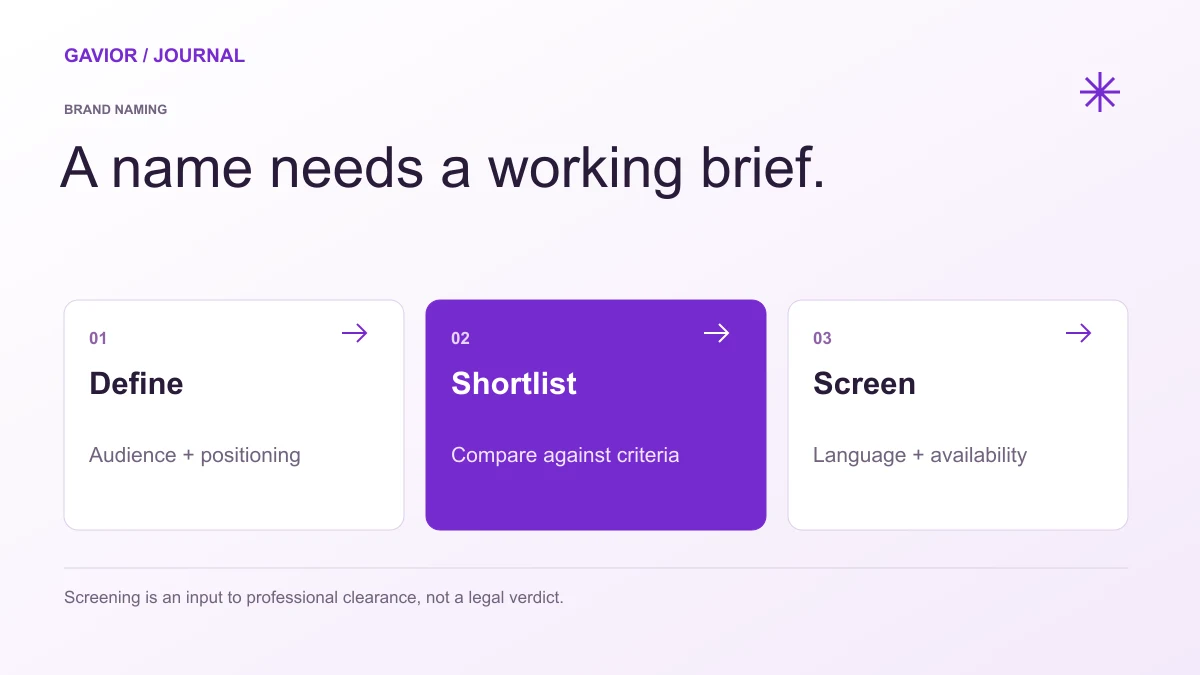
An original naming workflow. Screening does not replace professional clearance. View full-size image ↗
A brand naming agency helps a business define naming criteria, develop options and evaluate a shortlist against its positioning, audience and intended markets. A useful brief separates creative development, language checks, preliminary availability searches and professional trademark review, with a named owner for each decision.
Make your move
Ready to turn a better idea into a better business?
Disclosure: Gavior provides brand identity and design services. This guide is a practical briefing method, not a ranking of naming agencies or a promise that a proposed name can be registered. Use the startup branding agency buyer guide to compare the wider engagement.
What should you decide before asking for names?
Define the business being named, the first customer and the association the name should create. Explain whether you need a company name, a product name or a system for naming several products. These are different assignments, even when they share one launch date.
Consider an illustrative B2B maintenance platform. Its customer is an operations manager; its useful outcome is keeping service requests visible. A brief that asks for a name that feels "innovative and premium" leaves almost every decision open. A better brief asks for a clear, pronounceable name that works in sales conversations and does not imply services the product cannot provide.
This example is a planning exercise, not a Gavior client project. Replace its assumptions with evidence from your customers, sales calls and product positioning.
What belongs in a naming brief?
A naming brief should explain the intended meaning, practical constraints and approval process before creative work begins. Give shortlisted agencies the same brief so their proposals cover comparable work.
Brief field
What to provide
Why it changes the work
Naming object
Company, product, feature family or rebrand
Determines how the name must relate to existing brands
Audience
Buyer role, language and buying context
Shapes pronunciation, vocabulary and tone
Positioning
Customer problem, alternatives and credible difference
Gives the shortlist a reason beyond personal preference
Launch markets
Countries and languages being considered
Defines the scope of language and availability checks
Constraints
Existing names, forbidden meanings, length or domain preferences
Prevents unsuitable routes from consuming revision time
Decision owner
Approver, reviewers and feedback dates
Makes selection and revisions manageable
Screening ownership
Creative, language, domain and trademark-review owners
Separates an initial scan from a clearance decision
For a technical startup, add a plain-language explanation of what the technology changes for its customer. Ask the engineering team to identify claims that would exaggerate capability. A name should leave room for growth without making the current offer incomprehensible.
How should an agency present a shortlist?
A shortlist should explain each naming route, its intended association, pronunciation and practical trade-offs. Ask for the reasoning and screening notes alongside the name, rather than judging only a logo mockup or the number of suggestions delivered.
Use a simple decision record. Mark each criterion as essential or preferred before reviewing the options. An essential language or market constraint can reject an option; a preference should remain a discussion rather than becoming an invented numerical certainty.
Criterion
Review question
Useful evidence
Meaning
Does the name support the intended positioning?
A short explanation in the customer's language
Usability
Can people hear, say and type it in realistic situations?
Sales-introduction and spelling exercises
Product fit
Will it still make sense for the planned offer?
Example product, website and proposal uses
Confusion
Could customers reasonably mistake it for another offer?
Documented category and preliminary availability searches
Selection
Who approves it, with what unresolved questions?
A dated decision log and outstanding review owners
Do not present a few informal reactions as statistically reliable audience research. If audience testing is commissioned, define who participates, what they see and how the results will inform the decision.
Does an available domain mean the name is cleared?
Domain availability and trademark clearance answer different questions. A purchasable domain is one practical input; it does not establish that a name is suitable for every product category or market. Keep that distinction visible in the agency proposal and decision record.
WIPO's Global Brand Database guidance explains that its collections do not remove the need to consider national or regional registers, and that a trademark professional may be consulted. Agree the relevant search and review scope with qualified counsel before committing to a launch. An agency's creative shortlist should identify unresolved checks, not claim guaranteed registration.
What should the naming proposal and handover include?
The proposal should state the naming object, creative routes, shortlist format, revision boundary, screening responsibilities and final deliverables. It should also explain what happens if the preferred name fails a later review, before either side assumes a replacement is included.
Request a handover containing the selected spelling and capitalization, pronunciation guidance where needed, the positioning rationale, approved descriptor and remaining restrictions. If naming is part of a broader identity project, connect it to the brand identity handover checklist.
Separate the naming decision from domain purchases, trademark work, logo design and website implementation in the commercial scope. Some may be included in one engagement; the proposal should make that explicit. Your business should control any domain or account acquired for its brand.
Frequently asked questions
Can a naming agency work from an early startup idea?
Yes, but the brief still needs a target customer and a credible description of the offer. If these are unsettled, agree a positioning step before treating a name shortlist as the final launch decision.
Should naming come before the logo and website?
Resolve the naming direction and its required reviews before investing heavily in a finished identity. Early layout explorations can help evaluation, but they should not make an unreviewed name feel irrevocable.
How many names should an agency provide?
There is no universal number that makes a naming engagement good. Agree the number of routes, depth of explanation, shortlist and revision process. Evaluate suitability and reasoning rather than a large list without screening notes.
What should a startup send to Gavior?
Send the business or product being named, the customer, your positioning, intended launch markets and any existing shortlist. Explain which design or website deliverables you also need so the work can be scoped together.