Digital Marketing for Small Business: A 30-Day Plan
Gavior Editorial Team
Growth and website editorial team
Published: 2026-10-28Updated: 2026-10-28
Plan small-business digital marketing around one offer, a useful landing page and qualified enquiries. Connect campaign tracking, WhatsApp clicks and follow-up.
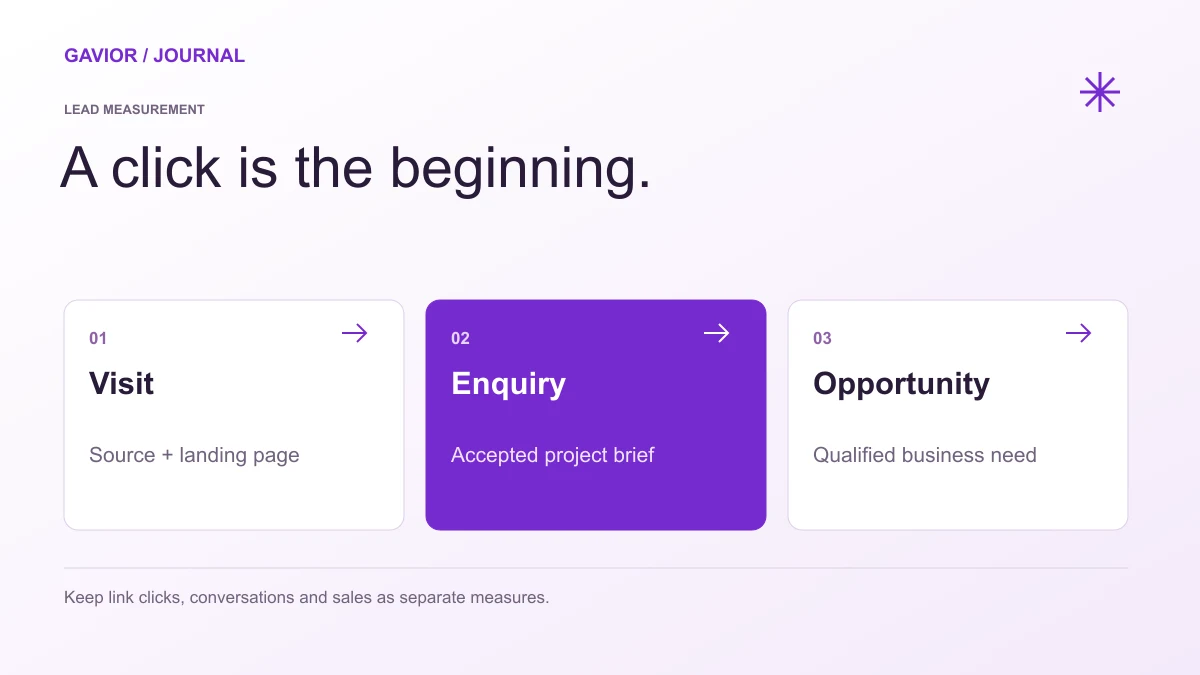
A click, an accepted enquiry and a qualified opportunity are different measures. View full-size image ↗
Digital marketing for a small business should connect a specific customer and offer to a landing page, a measurable enquiry action and follow-up. Start with qualified enquiries as the business outcome. Report visits, clicks, saved enquiries, qualified opportunities and sales separately so activity is not mistaken for revenue.
Make your move
Ready to turn a better idea into a better business?
Disclosure: Gavior provides websites and digital marketing services. This is a planning sequence, not a promise of leads in 30 days or a fixed advertising budget. The small-business marketing agency guide explains how to compare providers and account ownership.
What should the first campaign try to achieve?
Choose one audience, one offer and one next action before choosing a channel or publication frequency. Define what makes an enquiry relevant to your business so the team can evaluate the quality of the response, not only its volume.
For an illustrative development business, a useful enquiry might describe the customer's software problem, starting point and intended outcome. A job application, unrelated support request or test form submission should not count as the same result. Your definition should match your actual sales process.
Write down who will respond and where the enquiry is saved. A well-designed campaign still loses useful conversations when the destination is an unattended inbox or a number nobody checks.
Which landing page should receive the visitor?
Use a page that answers the promise in the campaign and makes its next step clear. Show who the service helps, what is included, relevant evidence, cost factors and what happens after someone enquires. Keep the action practical for someone using a phone.
Visitor question
What the page should show
Is this relevant to me?
A specific audience, problem and service description
Can this business do the work?
Honest project evidence and an explanation of its contribution
What can I ask for?
Defined engagement options, deliverables and scope boundaries
What affects the price?
Inputs and exclusions rather than an unsupported universal quote
What happens next?
A clear brief, call request or WhatsApp conversation path
How is my enquiry handled?
Contact choices, appropriate consent and a reliable saved result
For example, Gavior's SaaS development page connects an MVP enquiry to product evidence and scope options. A different service should use its own relevant page and proof. See the lead-generation website brief for a reusable structure.
What should you measure beyond clicks?
Measure the stages you can actually observe and name the gaps between them. A WhatsApp link click shows that a visitor opened a conversation path; it does not establish that a message was sent, answered or qualified.
Stage
Useful evidence
Limit of the measure
Search discovery
Relevant page impressions and clicks
Does not establish an enquiry or purchase
Website arrival
Landing page and source/medium
Attribution may be missing or incomplete
WhatsApp action
A recorded link click
Does not confirm a sent message
Saved enquiry
Server-accepted form record and reference
May include tests or unsuitable requests
Qualified opportunity
A reviewed enquiry matching your criteria
Requires a consistent sales decision
Sale
An agreed commercial outcome in business records
Should not be inferred from a page visit
In Google Analytics, identify the event that genuinely represents the intended action and decide which actions should be key events. Google's key-event guidance explains that marking an event affects future reporting rather than rewriting its history. Keep a successful enquiry event separate from generic form activity or validation attempts.
How should campaign links and enquiries be connected?
Use a documented campaign naming convention and a consistent way to connect an enquiry to its source where that source is known. Keep personal contact details and the customer's message out of campaign URLs and analytics event parameters.
Google's campaign URL guidance describes parameters such as source, medium and campaign, and notes that values are case-sensitive. Agree a small naming convention before publishing links. Random spelling changes create unnecessary reporting categories.
When a person chooses WhatsApp after visiting the page, a short non-personal campaign reference can help the receiving team understand the route. It still needs to be matched to the actual conversation and qualification outcome. Record unknown attribution as unknown instead of assigning every direct visit to the last campaign you launched.
What is a practical first 30-day sequence?
Use the first month to establish a working journey and gather interpretable evidence. Adjust the sequence to your available audience, traffic and review capacity; a calendar does not guarantee enough observations for a reliable conclusion.
Days 1–7: Define the offer, qualified-enquiry criteria, page and response owner. Test the enquiry route and exclude known tests from business reporting.
Days 8–14: Check campaign naming and the landing experience on phones. Publish useful answers to genuine buyer questions and record the starting metrics.
Days 15–21: Review where relevant visitors stop and what enquiries actually ask. Investigate a broken form or unclear offer before buying more traffic.
Days 22–30: Compare sources, landing pages and qualified outcomes. Document what to improve, what needs more data and which claims the data cannot yet support.
For paid distribution, agree a controlled test budget and decision criteria based on the business's economics. Keep advertising spend, management fees, creative production and website work separate in the commercial scope. Do not scale from a single click or a single test enquiry.
Frequently asked questions
Should every campaign link to the homepage?
Use the page that best answers the campaign's offer and audience. A broad homepage can introduce the business, while a specific service page may give a visitor a clearer path to an appropriate enquiry.
Does a WhatsApp click count as a qualified lead?
No. It is a measurable step toward a conversation. Qualification requires evidence that the person contacted the business and that the need matches the agreed criteria.
Can useful blog content guarantee AI citations or rankings?
No. Clear answers, evidence and crawlable pages support discovery, but appearance in a search result or generated answer remains outside a publisher's control. Evaluate relevant visibility and qualified enquiries over time.
Include the goal, period, spend where applicable, relevant traffic, observed actions, qualified enquiries and known measurement limits. Explain what changed and what decision the evidence supports rather than reporting a list of activity totals.