AI Content Autopilot: From SEO Research to CMS Publishing Without Losing Review Control
Gavior Editorial Team
ORBIT product editorial team
Published: 2026-09-02Updated: 2026-09-02
How an AI content autopilot should work: start with live SEO detection, build a focused content workflow, add review controls and publish through your CMS.
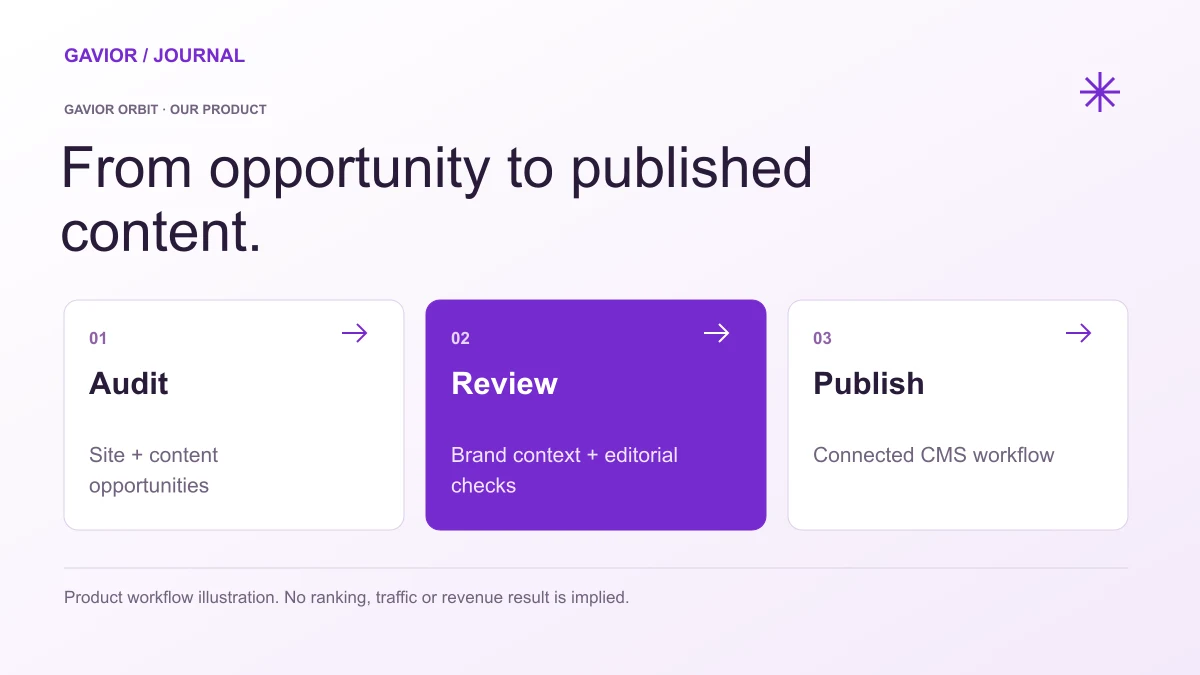
Workflow illustration for Gavior's own product; no search or business result is implied. View full-size image ↗
An AI content autopilot should not begin with “write 100 articles.” It should begin with a real page, a real audience and a content decision worth making. The useful version of automation connects the repetitive work—research, brief creation, drafting, optimisation and publishing preparation—while keeping the review controls a business needs to protect accuracy and brand trust.
Make your move
Ready to turn a better idea into a better business?
Gavior ORBIT is built around that workflow. You can start with a free live SEO detection on a public URL, then use a paid workspace when you need a more connected content operation.
Start with the page you already have
Before adding new content, inspect the current signal:
What is the page about?
Is the title, heading and description aligned with the buyer’s search?
Which technical or on-page issues are visible?
What content is missing for a person comparing options or making a decision?
Which existing pages should support the next article?
ORBIT’s free live SEO detection is designed for this first step. It reads a public page and returns SEO health, detected issues and passed checks without requiring an account. It is not a promise of a particular ranking; it is a practical way to see what the page needs next.
What an autopilot should automate
The goal is not to replace editorial responsibility. It is to make the parts that repeatedly slow a content team more connected.
Stage
Useful automation
Human responsibility
Discover
Collect page signals, topic ideas and search-intent context
Decide which opportunity matters to the business
Cluster
Organise related topics and identify supporting pages
Confirm audience, expertise and commercial relevance
Brief
Create a structure, questions, entities and link opportunities
Add first-hand knowledge, proof and constraints
Draft
Produce a working article from the approved brief
Fact-check claims, tune voice and approve the final position
Optimise
Check headings, coverage, links and page-level SEO signals
Make trade-offs for clarity, legality and brand quality
Publish
Prepare or send approved content through a connected CMS
Control permissions, scheduling and the final publish decision
This is where a good content system differs from a blank AI writer. It connects the job before and after the first draft.
ORBIT's content workflow
In a paid ORBIT workspace, teams can set a publishing cadence and target topic clusters, then use the workflow to organise research, drafts and publishing steps. The platform is designed to keep the content brief, optimisation context and CMS handoff in the same process.
For compatible setups, approved work can be prepared for or published through standard CMS APIs, including WordPress, Ghost and Webflow. The exact connector availability depends on the workspace plan and the connected CMS configuration.
That means the team does not need to treat every article as a separate copy-paste project. It can set a repeatable operating rhythm while retaining the checkpoints that fit its risk level.
Why review controls are a feature, not a compromise
Autopilot content can be risky when it publishes product claims, regulated guidance, customer proof or technical instructions without verification. An effective implementation defines who can:
Approve topic clusters and target markets
Supply subject-matter input and source material
Review facts, legal language and customer references
Edit the final brand voice
Schedule, publish or roll back a post
Google’s guidance does not prohibit AI-assisted content. It does require useful, reliable, people-first content and warns against scaled output made primarily to manipulate rankings. It also notes that explaining how automation was used can help when readers would reasonably expect that context. See Google’s people-first content guidance.
For a business, the standard is straightforward: automation should make the content operation more rigorous, not make the public site less trustworthy.
AI search visibility still starts with normal SEO
There is no special markup that guarantees a page will be cited in an AI answer. Google states that the same foundational SEO best practices apply to AI Overviews and AI Mode: pages need to be crawlable, indexed, useful, textually clear and eligible to appear in Search. Google’s AI features documentation also makes clear that eligibility does not guarantee crawling, indexing or serving.
An autopilot can help a team execute consistently. It cannot create authority, invent trustworthy evidence or guarantee a ranking. Strong content still needs clear claims, original experience, accurate sources and a site structure that lets readers move from an article to the relevant service or product page.
A practical first month with ORBIT
Run free SEO detection on one important public page.
Choose one narrow topic cluster connected to a real service or product.
Set an editorial cadence your team can actually review.
Create briefs that capture buyer questions, first-hand evidence and internal-link opportunities.
Review and approve the first published pieces closely.
Use search, conversion and sales feedback to improve the next cycle.
This approach is slower than generating hundreds of generic posts in a day. It is much more likely to create a useful, durable content library.